Logistics

Global Shipping & Logistics

Factory to site. On time. Every time. MODURA modules ship from certified manufacturing partners to project sites worldwide. We manage the entire logistics chain, export documentation, transport coordination, customs clearance, and final delivery, so you receive your building on schedule, undamaged, and ready to install.

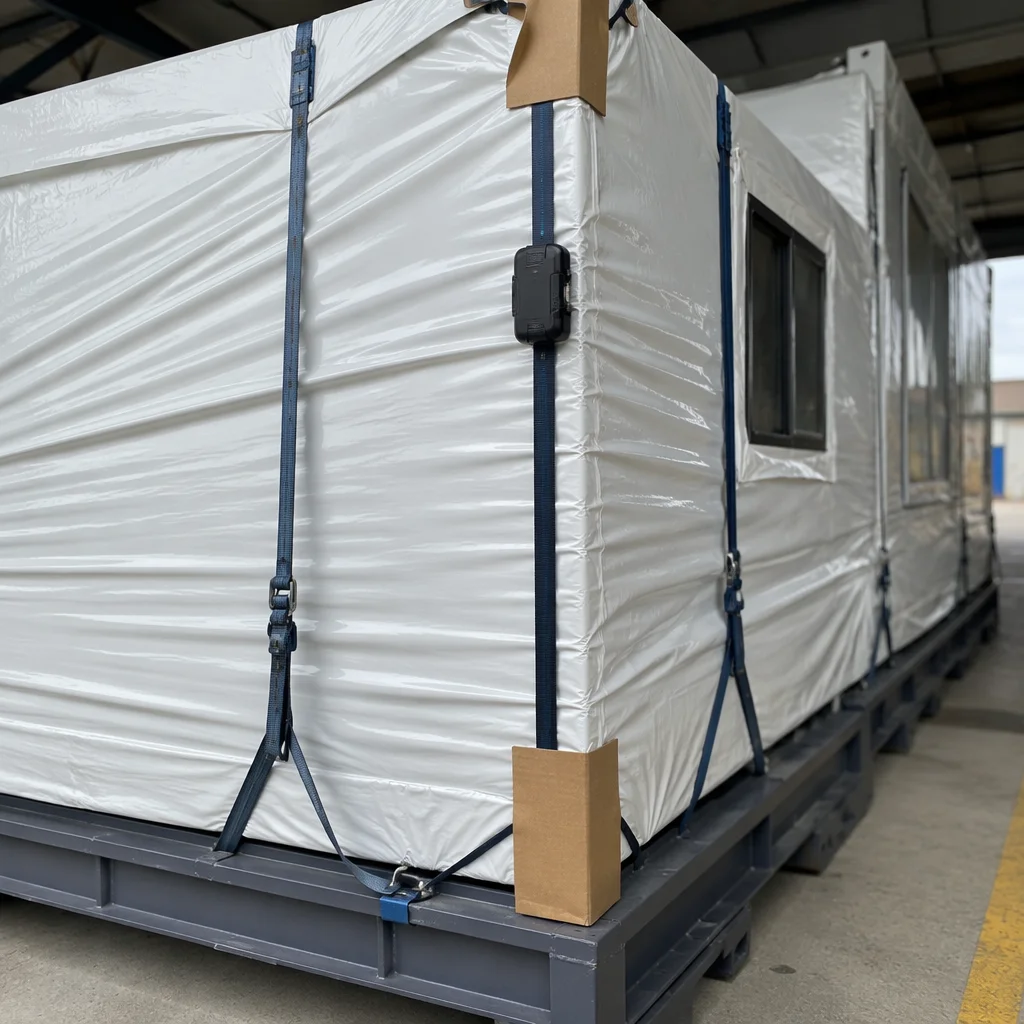
MODURA modules wrapped in weatherproof protective packaging secured on steel stillage frames ready for transport
Quality Assurance

Packaging & Protection Standards

Every MODURA module leaves the factory wrapped and secured to our military-grade packaging standard. Our packaging system has been refined over 10,000+ module shipments and is designed to protect your investment against weather, vibration, and handling loads during multi-modal international transport.

  • Weatherproof wrapping, breathable membrane plus reinforced polyethylene outer layer, preventing condensation while blocking rain and road spray
  • Steel stillage frames provide rigid support and enable forklift and crane handling without module contact
  • Corner edge protectors and anti-abrasion padding at all contact points between module and transport frame
  • Internal bracing for MEP fixtures, joinery, and glazing: every cabinet, appliance, and fitting secured for transport
  • GPS tracking device fitted to every module with geofence alerts and 15-minute position updates
  • ISO 668 containerised module dimensions for standard intermodal shipping compatibility
  • Marine-grade corrosion inhibitor applied to all exposed steel for sea freight shipments
  • All modules factory-sealed with desiccant packs to prevent internal condensation during transit
Logistics Capabilities

Transport Modes

Every project gets a custom logistics plan. We select the optimal transport mode, or combination of modes, based on your site location, project timeline, module dimensions, and budget. All transport is fully insured with real-time tracking.

Road Transport

Flatbed trailers with escort vehicles for oversized loads. Max 4.5m wide × 16m long × 3.6m high per module. UK and EU operators with abnormal load permits. Real-time GPS tracking throughout transit. Door-to-door delivery with crane offload coordination.

Sea Freight

ISO container-compatible modules in 40ft high cube or on flat rack. Roll-on/roll-off (RoRo) for volumetric modules. Regular sailings from Ningbo, Shanghai, and Guangzhou. 20–45 day transit to major global ports. All shipments covered by marine cargo insurance.

Rail Freight

Intermodal rail for long-distance overland transport. Modules transferred from factory to rail terminal on dedicated flat wagons. Cost-effective for continental Europe and North America cross-country routes. Reduced carbon footprint versus road-only delivery.

Air Freight

Emergency and critical path modules only. Specialized cargo aircraft (Antonov AN-124 / Boeing 747-8F). Module weight limit approximately 20 tonnes. 24–72 hour delivery. Used for disaster relief, urgent project phases, and remote site access where surface transport is impractical.

Delivery Timelines

Delivery Time Estimates

Transit times from each MODURA factory to major global destinations. Times shown are port-to-site or terminal-to-site and include customs clearance. All estimates based on standard shipping schedules and typical border processing.

Destination From Guangzhou From Ningbo From Shanghai From Hangzhou Mode
London / SE UK2–3 days, , , Road
Frankfurt / Central EU4–5 days, , , Road
Dubai / Middle East14–18 days, 12–16 days, Sea
New York / US East, 7–10 days28–35 days, Mixed
Los Angeles / US West, 2–3 days, , Road
Sydney / Australia, , 21–28 days, Sea
Lagos / West Africa18–22 days, , , Sea
Tokyo / Japan, 18–24 days14–18 days, Sea
Mexico City, , , 3–5 daysRoad
Singapore, , 1–2 days, Road
End-to-End Process

Shipping Process

Every module follows a documented 6-step shipping process with checkpoints, digital records, and client visibility at each stage. Our logistics team manages the entire chain, you receive one weekly report covering all modules in transit.

1. Module Completion & FAT

Module passes multipoint Factory Acceptance Test. Photographed from all angles with inspection records uploaded to the digital twin. Forklifted to dispatch bay and assigned to a shipping batch. Transport stillage prepared and pre-inspected.

2. Loading & Securing

Module lifted onto transport stillage. Weatherproof wrapping applied in layers. GPS tracker activated and signal verified. Load secured with rated straps and chains. Photographic evidence captured. Bill of lading issued with module serial numbers.

3. Customs Clearance (Export)

Export documentation package: commercial invoice, packing list, certificate of origin, mill certificates, and destination-market compliance declarations. Electronic customs clearance via CHIEF/CDS (UK) or equivalent system. Pre-lodged declarations where available.

4. In-Transit Monitoring

GPS position updated every 15 minutes via satellite/cellular. Shock and vibration sensors alert if module experiences transit forces exceeding 2g design limits. Temperature and humidity monitored inside module envelope. Client receives weekly consolidated logistics report.

5. Customs Clearance (Import)

Destination agent handles import clearance using pre-prepared documentation. Duties and tariffs estimated during project quoting phase and confirmed before shipment. HS code classification pre-confirmed with receiving country customs authority. Bonded warehousing available if required.

6. Site Delivery & Cranage

Module arrives on site on scheduled date. Mobile crane pre-positioned per lift plan. Module lifted directly from trailer to building position in correct installation sequence. Average 8–12 modules installed per day. Crane demobilized on schedule with zero standing time charges.

Worldwide Reach

Global Delivery Coverage

Containerized ocean freight from partner factories in East Asia covers US, European, and Middle East projects. Final-leg trucking is coordinated with local partners.

Europe & UK

Partner factories in East Asia dispatch by containerized ocean freight for the Americas, Europe, and the Middle East. European projects receive final-leg road delivery coordinated by local partners.

North America

US and Canadian deliveries land at West Coast or Gulf ports based on the project site. Rail and truck final-leg options are arranged by your local delivery partner.

Asia-Pacific

Shanghai and Ningbo handle Asia-Pacific and Oceania sailings, with competitive transit times to all major APAC ports.

Middle East & Africa

Dispatch is planned by destination: Ningbo/Shanghai for US West Coast and Europe; Guangzhou for Gulf ports and the Middle East. Each shipment ships with weekly status reports.

Freight Economics

What Freight Actually Costs You

Shipping is quoted as a lump sum, which makes it impossible to tell whether a number is competitive. These are the figures project buyers should be comparing, and the reason two quotes for the same building can differ by more than the building itself.

Cost lineTypical rangeWho controls itHow to reduce it
Ocean freight — 40ft HC container$2,400–$6,800 per containerCarrier + booking windowBook at forecast, not at completion. Rates on the same lane can move 30–40% between a booking made 8 weeks out and one made the week of loading.
Breakbulk / flat-rack for oversized modules$6,500–$18,000 per unitModule width you specifyAnything above 3.2m wide leaves containerised shipping entirely. Designing to 3.0m keeps you in the container fleet.
Origin port charges and terminal handling$380–$700 per containerPort, not supplierFixed. Be suspicious of a quote that omits these — they reappear as a destination surcharge.
Marine cargo insurance0.25–0.45% of declared valueYou, not the supplierAll-risk cover is cheap relative to the cargo. Confirm who the insured party is before loading, not after a claim.
Destination haulage — port to site$1,900–$9,500 per moduleSite distance and accessThe single largest variable. A site 40 km from the port and a site 900 km from the port share an identical ocean leg and nothing else.
Crane offload and placement$3,200–$7,400 per dayLift plan and site readinessSequence modules so the crane never waits. Standing time is charged, and it costs the same whether the crane lifts or idles.
Customs duty and import tariffs0–18% of declared valueHS classificationClassification decides this, and it is confirmed in writing before shipment. Modular buildings are not classified as vehicles, and a mis-declared HS code is the most expensive line-item error available.
Demurrage and detention$95–$340 per container per dayDocumentation timingEntirely avoidable. It happens when clearance documents are incomplete at arrival. Pre-lodged declarations eliminate it.

For the mode-by-mode comparison including RoRo versus flat-rack decisions, see our guide to modular construction transportation and logistics, and for documentation and tariff handling across borders, cross-border international logistics. A practical benchmark: for a 24-module apartment project shipping 8,000 km, logistics lands at 11–16% of the delivered building value. Buyers who model that number before signing avoid the two most common overruns — destination haulage and crane standing time, which together account for roughly two-thirds of project logistics variance. See how the freight line sits inside the total programme in our seven-phase delivery process.

Risk Allocation

Where Risk Transfers — and When

Transit damage disputes are almost never about the damage. They are about who was responsible for the thirty minutes in which it happened. This is the allocation we work to, and the one worth writing into your contract.

StageWho bears the riskCover in forceEvidence that decides the claim
In factory to dispatch bayManufacturing partnerProduction & premises insuranceFAT report and dated dispatch photographs from all four elevations.
Loading and lashingManufacturing partnerBailment coverLashing plan signed off against the transport engineer’s tie-down drawing.
Ocean / main carriageCarrier — limited liabilityMarine cargo insuranceSeal record and container or flat-rack condition report at origin.
Port terminal handlingTerminal operatorTerminal liability, cappedDamage photographed before the module leaves the terminal gate.
Destination road haulageHaulierCMR / motor cargo coverImpact and tilt-logger readings from the in-transit sensor package.
Crane offload and placementClient’s lifting contractorContractor all-riskSigned lift plan and pre-lift condition survey countersigned by both parties.
After placement on foundationsClientBuilder’s riskHandover acceptance, then warranty terms apply to defects rather than transit damage.

The point of this table is the fourth column. Risk allocation is only enforceable if the evidence exists at the moment risk transfers — which is why every module ships with a GPS tracker, a shock and tilt logger, and a photographic record taken on a fixed schedule. A claim with sensor data attached is settled in days. The same claim without it becomes a negotiation about memory. Our quality gates are documented the same way — see what a failed factory gate costs and how we verify a reference project. Crane and heavy-lift sequencing is covered in detail in crane and equipment logistics, and the insurance side of transit risk in construction insurance and risk management.

Before You Sign

Logistics Questions We Are Asked Before Every Export Contract

These are the five questions that come up in nearly every logistics review. Short answers here; the working detail goes into your project logistics plan within 48 hours.

Who is liable if a module arrives damaged?

Whoever held it at the moment of impact, and the sensor log establishes that. Liability is not a matter of argument in the contract — it is a matter of which stage the tilt logger recorded. Every module carries a GPS tracker plus shock, tilt, temperature and humidity sensors, and the log belongs to you on delivery.

What happens if my site is not ready when the ship arrives?

You choose between port storage at roughly $30–$85 per module per day, or bonded warehousing. Both are cheaper than demurrage on a loaded flat-rack. This is why we require a signed site-readiness confirmation two weeks before loading, not on arrival.

Can you ship to a site with no road access to the last mile?

Sometimes, and the answer is decided by module width, not by distance. Modules up to 3.0m wide travel containerised to the nearest intermodal terminal. Beyond that, we assess the last-mile route in advance — bridge load ratings, overhead clearance, turning radii and permit lead times all get checked before quoting, because a road that cannot take the load is a redesign, not a detour.

Who pays if customs hold the shipment?

Duty and tariff are yours as importer of record; delay caused by defective documentation is ours. That boundary is why the export package — commercial invoice, packing list, certificate of origin, mill certificates and market-compliance declarations — is pre-lodged where the destination customs system supports it.

Is the freight cost fixed at contract signature?

Ocean freight is quoted against a named booking window and is fixed within it. Destination haulage and crane time are quoted as ranges because they depend on your site. Any supplier quoting a single fixed logistics figure 12 months before shipping is either absorbing a rate risk into the building price or planning to revisit it — ask which. We set out how freight sits against the full project budget in our turnkey construction guide, and how the draw schedule should be structured around shipment milestones in payment draw schedules.

0 Countries Delivered
0 Modules Shipped
0 On-Time Delivery
0 Dispatch Ports

Request a Logistics Plan

Tell us your project location and we will prepare a detailed shipping assessment, route options, transit times, cost estimates, and customs requirements, within 48 hours.

Request Logistics Plan