The construction industry has a sustainability problem. Buildings account for 39% of global carbon emissions, 11% from operational energy and 28% from embodied carbon in materials and construction processes. Traditional construction is inherently wasteful: material off-cuts pile up in dumpsters, weather ruins exposed materials, and over-ordering is standard practice to avoid shortages.
Modular construction doesn't just incrementally improve this, it restructures the entire building process around efficiency. The result: 70% less waste, 30% lower embodied carbon, and buildings designed for eventual disassembly and reuse.
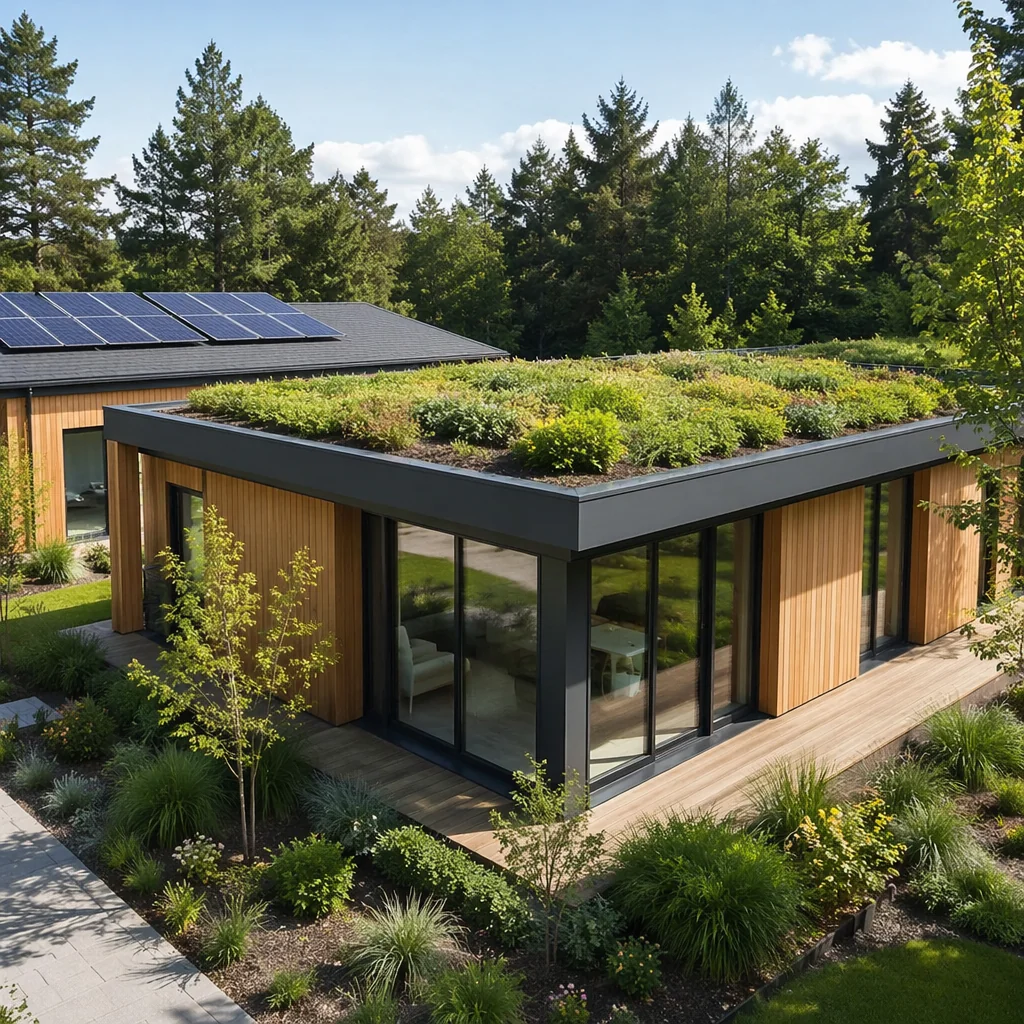
Waste Reduction: 70% Less Going to Landfill
On a traditional construction site, 15-20% of all materials delivered end up as waste. Drywall off-cuts, lumber scraps, damaged insulation, over-ordered materials, it all goes to landfill. The Construction & Demolition (C&D) sector generates over 600 million tons of waste annually in the US alone.
In our factory, waste is engineered out of the process:
- CNC cutting optimization: Software nests cutting patterns to minimize off-cuts, similar to how garment factories optimize fabric use
- Just-in-time material delivery: Materials arrive when needed, no weather damage from on-site storage
- Off-cut recycling: Steel, wood, and drywall off-cuts are sorted and recycled at the factory, not thrown in a dumpster
- Quality control eliminates rework: Defective work is caught at the workstation, not after installation
Our measured waste rate: under 3% of materials by weight. That's a 70% reduction compared to the industry average.
On a 100-unit apartment project, traditional construction sends approximately 120 tons of waste to landfill. Our modular process sends less than 35 tons, and 80% of that is recycled, not landfilled.
Embodied Carbon: 30% Lower Per Square Meter
Embodied carbon, the CO₂ emitted during material production, transport, and construction, is the construction industry's hidden climate impact. While operational energy efficiency gets most of the attention (solar panels, insulation, heat pumps), embodied carbon accounts for over half of a new building's 10-year carbon footprint.
How Modular Reduces Embodied Carbon
- Material efficiency: CNC-optimized cutting means less material purchased, transported, and wasted
- Fewer transport trips: Modules ship as finished units, replacing dozens of material delivery trips to a construction site
- Reduced on-site equipment: Less crane time, fewer generator hours, shorter site mobilization period
- Structural optimization: BIM engineering optimizes steel and concrete quantities to precise loads, not conservative estimates
Our lifecycle assessment (LCA) data shows modular buildings achieve 30% lower embodied carbon per square meter compared to equivalent traditional builds, before accounting for the operational energy savings.
Operational Energy: 25% Above Code
Modular buildings aren't just greener to build, they're greener to operate. The precision of factory construction creates tighter building envelopes with fewer air leaks and thermal bridges.
Why Factory-Built Envelopes Perform Better
- Air sealing: Factory-controlled conditions allow for meticulous air sealing, our modules test at 0.15 ACH50, well below the 0.40 ACH50 Passive House requirement
- Insulation consistency: No gaps, compression, or moisture damage from on-site installation in adverse weather
- Thermal bridge elimination: Precision-engineered connections between modules eliminate thermal bridges common in traditional construction
- Window installation: Factory-installed windows are sealed and tested under controlled conditions
The result: our standard modular buildings exceed International Energy Conservation Code (IECC) requirements by 25%. Optional net-zero-ready packages are available for projects targeting full carbon neutrality.
Designed for Disassembly: The Circular Building
Perhaps the most significant sustainability advantage of modular construction is one most people never think about: what happens at the end of the building's life?
Traditional buildings are demolished. The concrete is crushed, the steel is recycled (at significant energy cost), and everything else goes to landfill. A 50-year-old building produces as much waste in demolition as it did in construction.
Modular buildings are designed for disassembly. Our modules are connected with bolted connections, not welded or permanently bonded joints. This means:
- Relocation: An entire building can be disassembled, transported, and reassembled on a new site
- Repurposing: Individual modules can be removed and repurposed, an apartment module becomes a classroom, a hotel room becomes a remote office
- Component recovery: Steel frames, windows, doors, and fixtures can be recovered and reused at end of life
ESG Reporting and Certification
For developers and investors with ESG commitments, modular construction provides verifiable, quantifiable sustainability data that traditional construction cannot match:
- LEED Certification: Our buildings typically achieve LEED Silver to Platinum, with points available for construction waste management, regional materials, and design for flexibility
- BREEAM: Excellent rating achievable with our standard specifications
- WELL Building Standard: Factory-installed finishes use low-VOC materials, supporting indoor air quality credits
- Carbon accounting: Our LCA data provides per-project embodied and operational carbon figures for Scope 3 reporting
Real Data: 100-Unit Apartment Project LCA
Here's a lifecycle assessment comparison from a recent 100-unit apartment project, measured over a 50-year building lifespan:
- Embodied carbon: 1,850 tons CO₂e (modular) vs. 2,650 tons (traditional), 30% reduction
- Construction waste: 35 tons (modular) vs. 120 tons (traditional), 71% reduction
- Operational energy: 28% below IECC baseline (modular) vs. code minimum (traditional)
- Water usage during construction: 45% less (factory recycles process water)
- End-of-life recovery rate: 85% of materials recoverable (modular) vs. 30% (traditional demolition)
Where the Carbon Actually Sits, Line by Line
“30% lower embodied carbon” is a useful headline and a useless procurement number. The reduction is not spread evenly across the building: the structure carries a large share, MEP and finishes carry the rest, and one line, transport, moves in the opposite direction. This is the breakdown we hand to a developer’s sustainability consultant before an LCA is commissioned, because each line is verified by a different document:
| Life-Cycle Stage | Typical Share of Embodied Carbon | Modular vs Traditional | Verified By |
|---|---|---|---|
| A1–A3 Product stage (materials extraction & manufacture) | 55–65% | 5–12% lower. Steel frames and concrete slabs dominate this stage and the material mix is similar to site-built, so the saving comes from tighter factory nesting and cut optimisation, not a different structure | EPD for every major material; quantity take-off from the factory model |
| A4–A5 Construction process (transport & site works) | 8–15% under modular; 15–25% under traditional | Net lower, and this is the most misunderstood line. Freight per module is higher in absolute tonnes-km, but site plant hours, temporary power, dewatering and crane time fall far more, because the weather-exposed phase compresses from months to days | Site fuel and plant logs; freight tonnage records |
| B4–B5 Replacement and refurbishment | 10–15% | 15–25% lower. Serviceable connections and accessible MEP runs mean a component can be swapped without demolition, which is where a circular-design building separates from a conventional one | Maintenance schedule; component replacement plan |
| C1–C4 End of life (demolition & disposal) | 3–8% | 50–70% lower. This is the largest percentage reduction of any stage, because modules are lifted out and reused rather than crushed on site. It is also the stage most often excluded from an LCA scoped to cradle-to-gate | Deconstruction plan; material recovery certificates |
| D Beyond the system boundary (reuse & recovery credit) | Reported separately, can be negative | Frequently the largest single number in the report. Relocated modules displace new construction entirely, and a whole-module reuse credit is worth many times the recycling credit a demolished building can claim | Second-life building record; avoided-product calculation |
The practical caution sits in the A4 stage. A modular project assembled from a factory 4,000 km from site can lose its transport advantage entirely, and that is a real limit rather than a marketing point, so it belongs in the LCA scope from the start. Where the transport distance is material, the structure itself matters less than the factory-to-site distance, and that trade-off is set out in our steel frame comparison.
Certification Is Where Most Sustainability Claims Fail
A developer does not get paid for a lower carbon number. They get paid for a certificate, a planning approval, or an ESG disclosure that a lender accepts. Those three audiences ask for different evidence, and a project that only holds an LCA model will fail at least one of them:
| Audience | What They Actually Ask For | Where Modular Helps | Where It Does Not |
|---|---|---|---|
| Green building rating body | Documented material credits, construction waste diversion, and an as-built energy model that matches commissioning | Waste diversion evidence is generated continuously in the factory rather than reconstructed from site tickets, and factory QA closes the gap between the modelled envelope and the built one | Site-specific credits such as local sourcing and site ecology are unaffected by the delivery method. The full credit map is in our LEED certification guide |
| Planning authority | Operational energy and overheating evidence, plus a credible construction programme | A factory-tested envelope yields tighter airtightness than a site-built one, which is the input most often missing from an overheating assessment | Local design codes and appearance conditions still apply building by building |
| ESG reporting / lender | A traceable, auditable record linking the claim to a document, at portfolio scale | Every module carries a digital material and test record, so the same evidence chain repeats across a portfolio without re-auditing each site | Scope 3 accounting boundaries are a reporting decision, not a construction one. The finance-side view is in our construction financing guide |
Questions the Sustainability Team Asks Before They Sign
These are the questions that recur in nearly every sustainability-led modular enquiry, from a single developer to a fund writing a portfolio policy. We answer them in writing, because each one becomes a condition in the specification:
- “Is the 30% carbon figure a whole-building LCA or a partial one?” It is a whole-building cradle-to-grave comparison against an equivalent traditional build on the same site, using the same functional unit. Be sceptical of any lower figure quoted cradle-to-gate, because that scope excludes exactly the end-of-life stage where modular is strongest. Our method and the model outputs are explained in the LCA project case below.
- “Can you prove the waste diversion, or is it a target?” Factory waste is weighed and recorded per production run, so diversion is reported from logs rather than estimated from site skip tickets. This is the single most defensible number in the package and it is why we report it per project, not as an average. The process detail is in waste-to-energy and diversion.
- “What happens to the modules at end of life?” They are designed to be unbolted at the structural joints and lifted out, so the default path is relocation or reuse rather than demolition. That is a design decision made at the outset, not a claim made at handover, and it is set out in our design for disassembly guide.
- “Does the factory-built envelope really perform better than site-built?” On airtightness, usually yes, because the same trained crew builds every unit under cover and each one is pressure-tested before shipment. What varies is the thermal bridge detailing at the module-to-module joint, which is where a poorly designed modular envelope loses its advantage. The joining detail is covered in thermal insulation and energy code.
- “Does modular help or hurt a net-zero target?” It helps on embodied carbon and usually on operational energy, but it does not by itself deliver net zero, because that depends on the on-site renewable strategy. A storey-built plant array and its storage are the decisive inputs, covered in net-zero energy buildings. Our energy performance approach is in energy efficiency buildings.
- “What evidence pack do we get for the ESG report?” Per-module material certifications, EPDs for the major materials, the construction waste log, the LCA model and its assumptions, and the airtightness test certificates. That pack is assembled as the building is built rather than reconstructed afterwards, which is the practical difference for a fund reporting across a portfolio. Relevant to occupier wellbeing credits too: biophilic design & WELL certification.
The Bigger Picture
The construction industry is at an inflection point. Developers, investors, and governments are increasingly demanding verifiable sustainability, not greenwashing, but measurable reductions in waste, carbon, and resource consumption.
Modular construction delivers this not through add-on features or premium materials, but through a fundamentally more efficient process. It's the difference between making a car by hand in a driveway and making it on a factory production line. The factory isn't just faster and cheaper, it's inherently less wasteful.
For ESG-focused developers, the choice is increasingly clear. The greenest building is the one that's built with the least waste, the lowest carbon, and the longest reusable life. That building is modular.
Want a project-specific environmental impact assessment? Contact our sustainability team for a free LCA analysis tailored to your project.