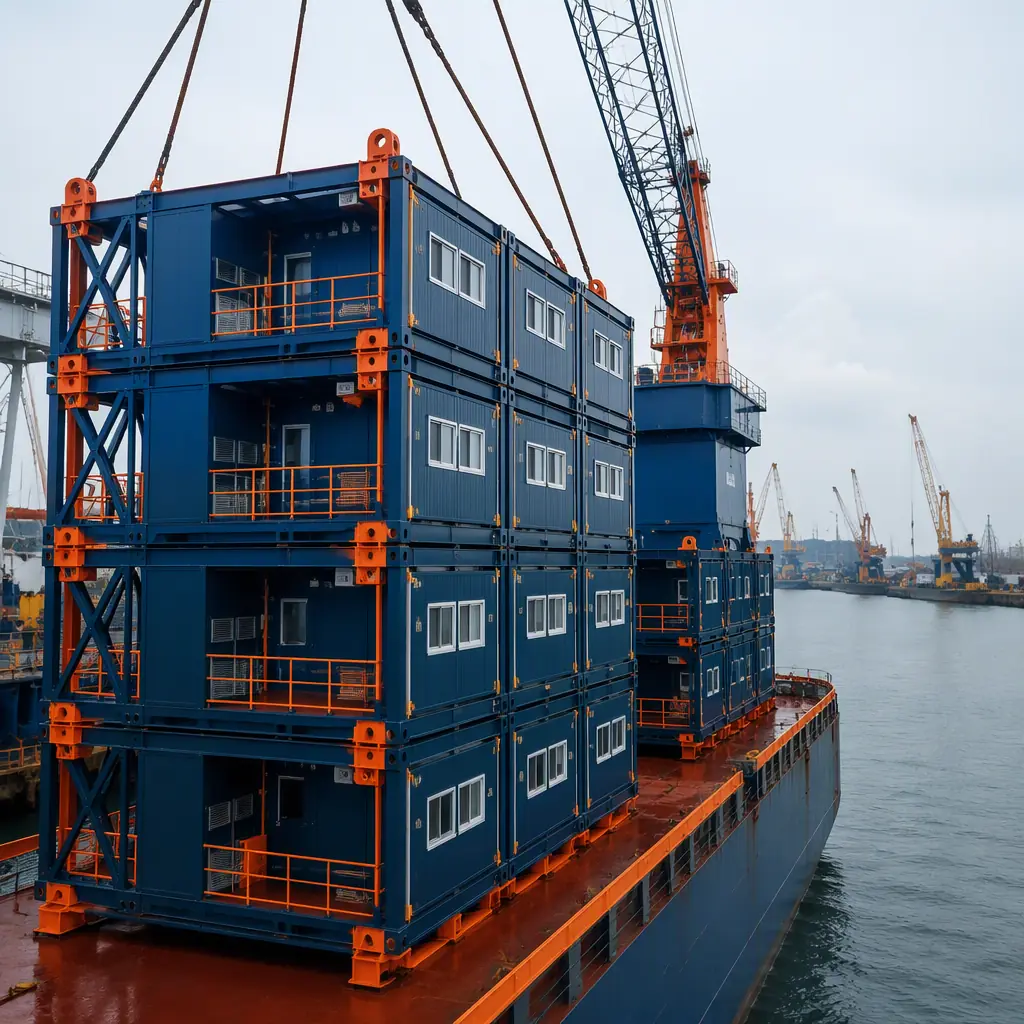
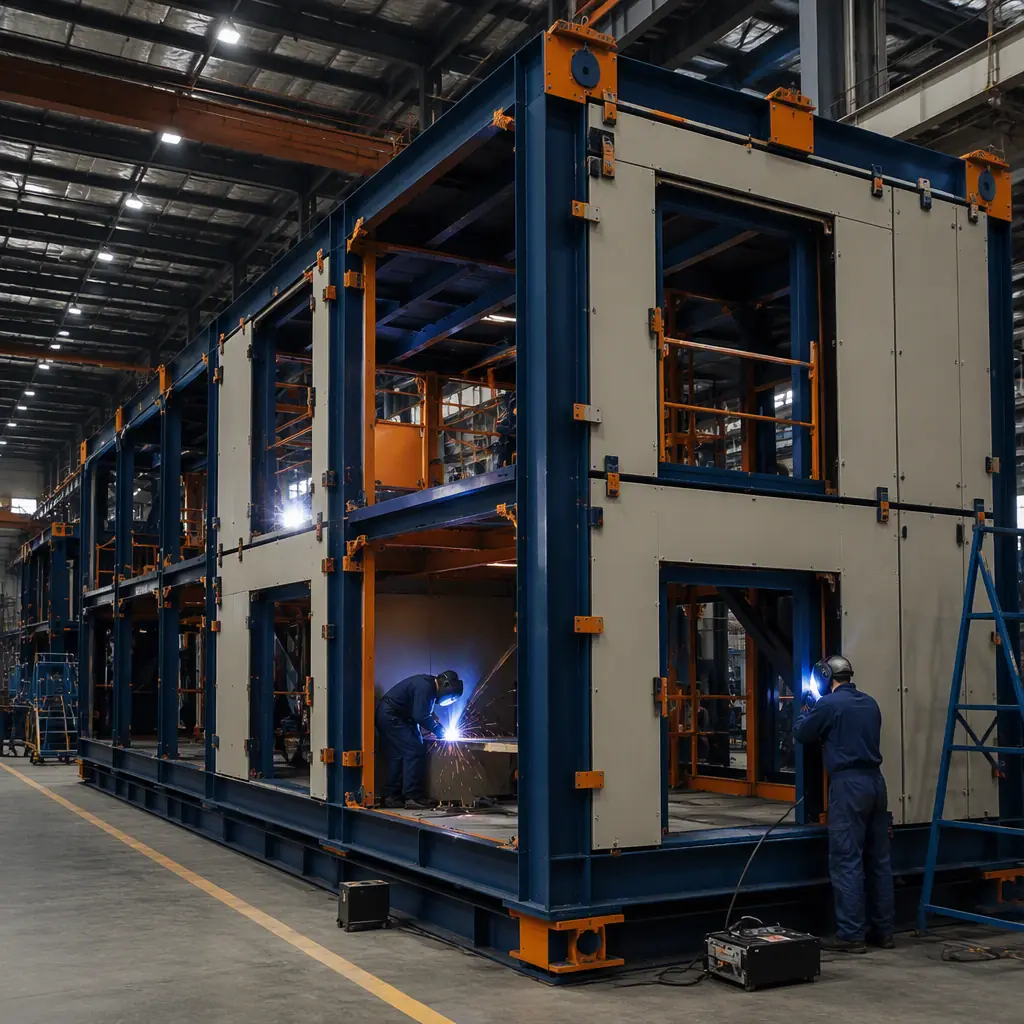
Offshore energy operations live or die on accommodation: every platform, drilling rig, and offshore wind substation needs quarters for the crew that keeps it running, blast-resistant living modules, galley and mess units, control rooms, medical facilities, and the marine support buildings onshore that provision the whole operation. These are the most demanding buildings in construction: engineered to NORSOK and EEMUA standards, rated for blast overpressure, built to survive marine corrosion, and transported on barges and lifted by heavy cranes onto decks that may be 50 meters above the sea. Conventionally fabricated, a 60-person quarters module package takes 14–24 months and commands premium offshore fabrication pricing. Modular prefabricated construction is the industry's native delivery method, the quarters are factory-built as steel-frame modules, blast-tested and outfitted in the plant, then transported and lifted into place as complete units, the same factory-built logic we document for modular heavy industrial construction, applied to the most corrosive, regulated environment in the built world. This guide covers offshore accommodation modules, blast and marine engineering, transport and lifting, onshore marine support facilities, cost structure, and certification for operators, EPC contractors, and marine infrastructure developers.
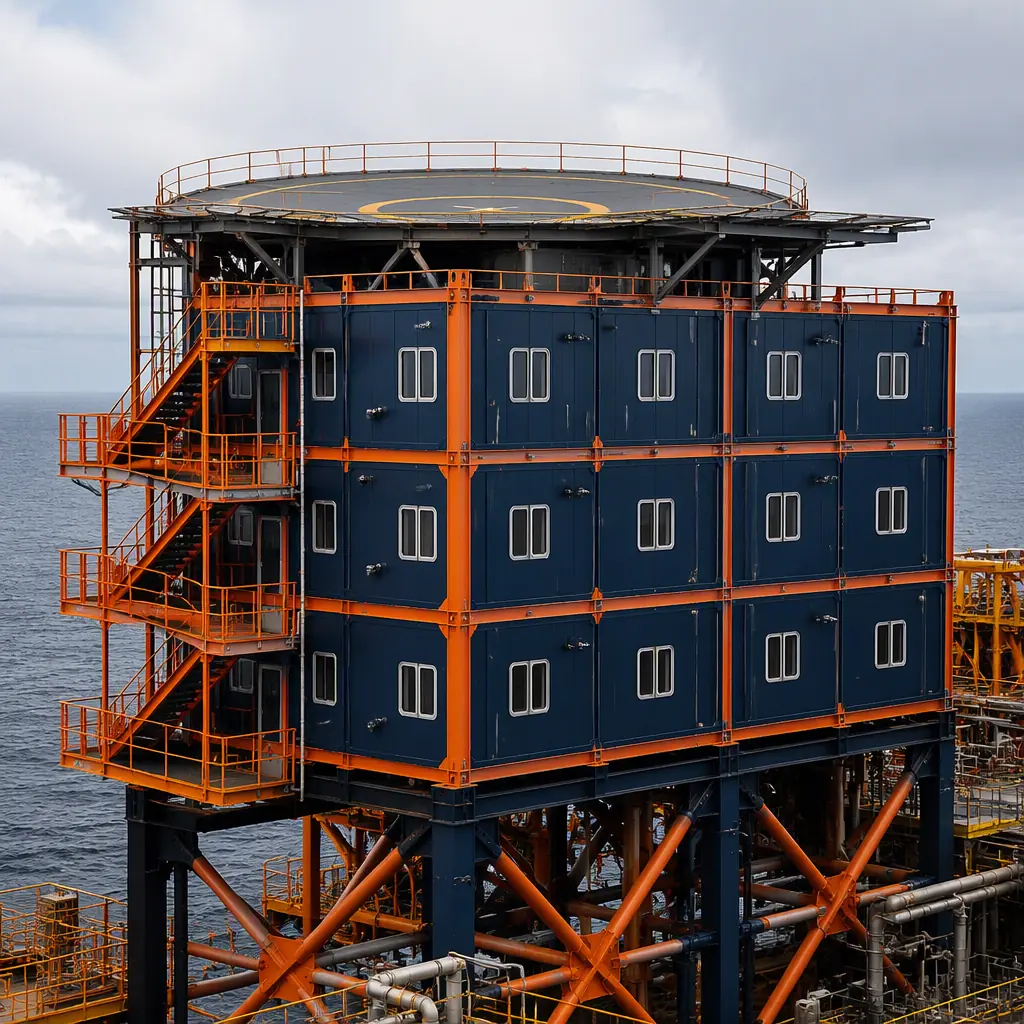
Why Offshore Quarters Are a Different Building Species
An offshore accommodation module looks like a shipping container and performs like a pressure vessel. Five engineering disciplines separate it from every onshore building type:
- Blast resistance is a life-safety requirement. Offshore platforms carry hydrocarbons under pressure, and quarters must survive a defined blast overpressure without progressive collapse. Blast walls are engineered to a specified design load (commonly 0.3–1.0 bar overpressure), and the module structure is analyzed as a blast-rated assembly, the safety-and-compliance discipline we document for modular construction site safety, taken to its structural extreme.
- Marine corrosion governs every material. Salt-laden atmosphere, splash zones, and permanent humidity attack steel at rates that make onshore coatings fail in months. Offshore modules use marine-grade coatings, corrosion-resistant fasteners, and sealed penetrations throughout, a materials discipline detailed in our coastal and flood-resistant construction guide.
- Dynamic loads are permanent. A module on a platform experiences wave-induced motion, helicopter landings on the deck above, and crane impacts. Structure and contents are engineered for dynamic loading that onshore codes never consider.
- Weight is budget. Every tonne of quarters is a tonne of platform deck capacity, so modules are weight-optimized in the factory, the structural-efficiency logic we document for modular steel construction, where the structure is engineered to its exact load path rather than over-built.
- Transport defines the design. Modules must fit barge decks, pass under bridges, survive sea state, and lift onto the platform. The transport envelope is fixed before the structure is designed, the logistics-first approach we detail for modular construction transportation and logistics.
The result is a building type where the factory is not an advantage but a necessity: blast-tested welds, marine-coated steel, and weight-optimized structure are all plant-controlled processes.
Procurement teams ask for the design basis in numbers, not adjectives. The table below sets out the load cases a quarters package is normally engineered against, and where each one is verified. Values are per-project and confirmed against the platform's safety case, but these ranges reflect what a North Sea or Gulf of Mexico asset typically specifies.
| Design case | Typical offshore specification | Verified by | What it protects |
|---|---|---|---|
| Blast overpressure | 0.3–1.0 bar peak, 100–300 ms duration, applied to the quarters-facing wall | Non-linear structural analysis plus panel qualification test | Structural integrity and escape-route preservation after an explosion event |
| Dropped object | 5–20 kJ impact energy depending on crane lift height and object mass | Deck and roof slab calculation, local reinforcement detail | Roof and deck penetration over occupied cabins |
| Helicopter landing | Static plus dynamic landing load per CA A / CAP 437 guidance | Helideck structure calculation and load test | Deck plate, support structure and tie-downs |
| Wave and vessel motion | Design accelerations from the transport sea state, not the operating location | Sea-fastening analysis and barge transit plan | Structure, racking of partitions, loose equipment tie-down |
| Wind loading | Site-specific basic wind speed, plus shielding from adjacent structures | Cladding and fixing design against wind uplift | Facade panels and roof covering |
| Fatigue | Cyclic stress from wave and machinery vibration over design life | Detail category check at welded connections | Long-term cracking at structural joints |
| Fire and hydrocarbon jet | H-rated divisions on escape routes, jet-fire rated walls where the safety case requires | Certified wall system test evidence, not a calculated claim | Evacuation time and safe refuge |
This is where factory fabrication earns its cost. Each of these load cases is verified on a physical assembly under a surveyor's witness in the plant, and the test evidence travels with the module serial number. On a stick-built offshore campaign the same evidence has to be assembled from a dispersed site where the wall that was tested may not be the wall that was installed.
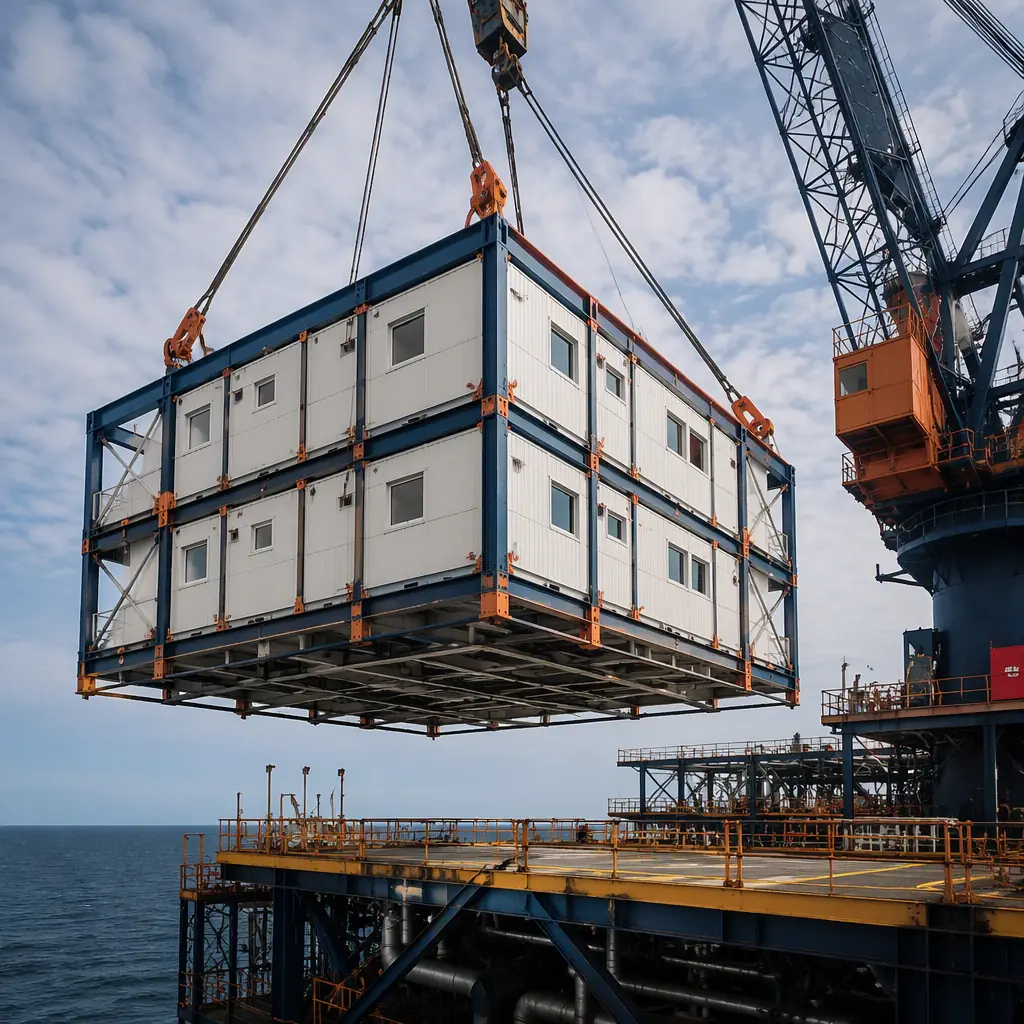
The Offshore Module Package
An offshore accommodation program divides into modules that are fabricated, outfitted, blast-rated, and certified in the plant, then integrated offshore:
Accommodation & Quarters Modules
Quarters modules carry the crew: sleeping cabins (single and double), bathrooms, laundry, and day rooms, with the corridor and escape-route geometry engineered to offshore egress standards. Modules are sized to platform lifting capacity: typically 3–4.5 m wide, 10–15 m long, 20–45 tonnes, and stacked or arranged around the platform's existing deck. Each module is outfitted with HVAC sized for offshore climate, fire and gas detection, and the public-address and alarm systems that platform life-safety requires. The same crew-accommodation logic applies to remote workforce housing onshore, but offshore modules add blast walls, marine coatings, and dynamic-load engineering.
Galley, Mess, Medical & Control Modules
The galley and mess module feeds the crew with a commercial kitchen engineered for marine motion, equipment tied down, gimbaled where needed, and ventilation sized for the menu, the industrial food-service logic we document for heavy industrial facility construction. Medical modules carry the clinic and isolation space offshore platforms are required to provide, and control-room modules house the platform's operations and monitoring functions with the precision power and cooling we cover for modular data center construction.
Helideck & Deck Integration
Large quarters packages integrate helideck support: the module structure is designed to carry helicopter landing loads, with the deck grating, tie-downs, and fire-fighting systems integrated in the factory. Deck integration is engineered as an interface package, the module's structural, piping, electrical, and HVAC connections terminate at defined interface points that mate with the platform's existing systems, the same interface-discipline we document for modular MEP systems integration.
Marine Transport, Lifting & Installation
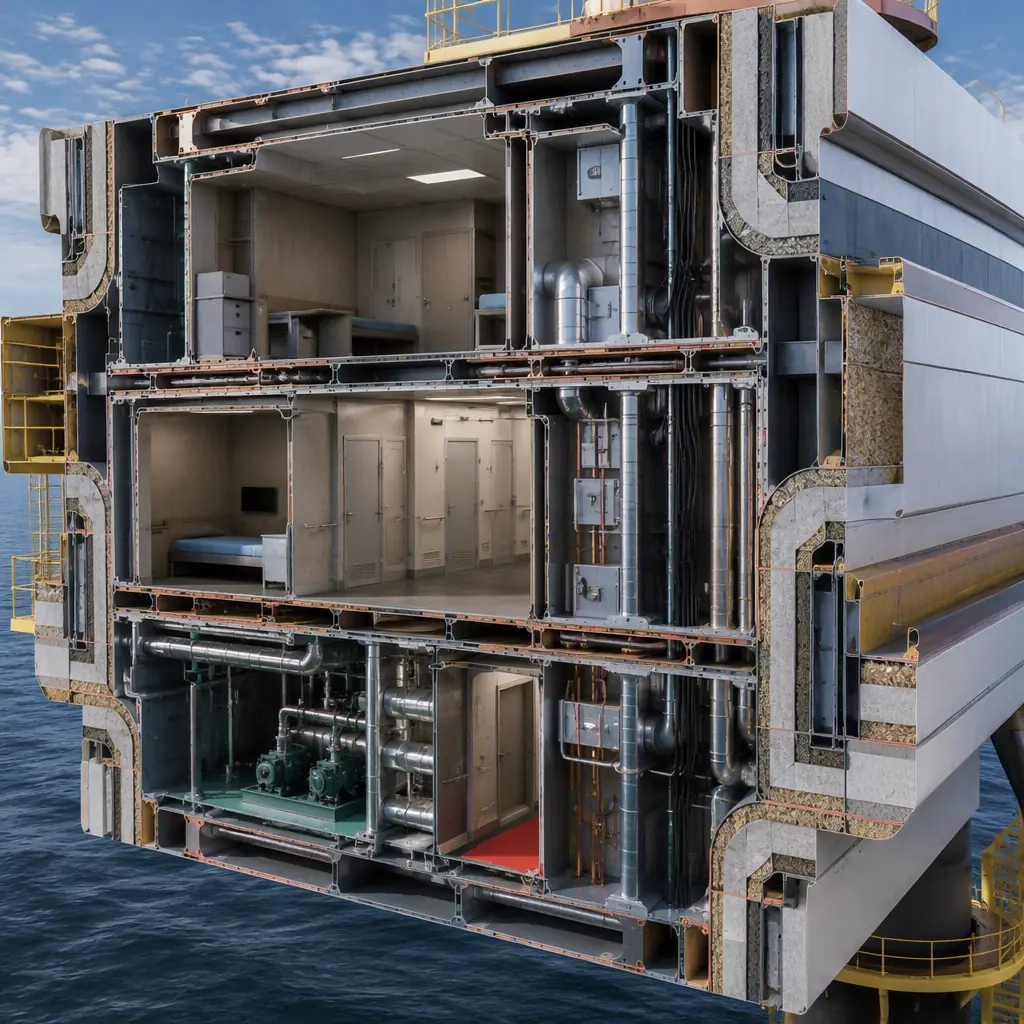
Getting a quarters module from factory to platform is an engineered campaign, and modular delivery plans it as precisely as the building itself. Modules are transported by road to the load-out port, lifted onto a cargo barge, sea-fastened for the voyage, and lifted onto the platform by a heavy crane or the platform's own pedestal crane, the crane and rigging engineering we document for modular crane equipment and logistics. The schedule advantage is structural: because the quarters arrive as complete, tested units, offshore installation is measured in days of lifting and hook-up rather than months of site fabrication, the critical-path compression we detail for modular construction scheduling. For platform life-extension projects, new quarters modules are lifted into place while production continues, with hook-up scheduled into planned shutdown windows.
Onshore Marine Support & O&M Facilities
Behind every offshore installation stands an onshore support network: operation and maintenance (O&M) bases, crew-change and training facilities, warehousing, and fabrication support buildings at the ports that service the platforms and wind farms. These follow the same modular logic as the offshore units, factory-built steel-frame buildings delivered fast on constrained port sites, and are covered by the same delivery playbook we document for modular industrial and warehouse construction and transit and depot facilities. For offshore wind, the O&M base is the critical enabler: it must be operational before the first turbine is installed, and modular delivery compresses that schedule by months.
Port sites have their own design problem: they are simultaneously wind-exposed, salt-laden, and under a live operations regime. A crew-change terminal cannot be closed for construction because vessels still dock alongside it. Modular delivery solves the sequencing rather than the salt: the building is completed and coated in the plant, then set on foundations during a short possession window, with only final connections and commissioning left on the quay.
The corrosion strategy below is the split normally specified for a port-located module. The exposure categories follow ISO 12944, and the point of listing them is that the category dictates the coating system, the surface preparation grade, and the interval before first major maintenance. Specifying an anonymous "marine coating" is what produces a building that needs repainting in year three.
| Module zone | ISO 12944 category | Typical coating build-up | First major maintenance |
|---|---|---|---|
| Exterior walls, roof, and cladding | C5-M (very high, marine) | Zinc-rich primer, epoxy intermediate, polyurethane topcoat; hot-dip galvanised secondary steel | 12–15 years with a wash-down regime |
| Splash and deck wet zones | C5-M with CX consideration where wave-washed | Higher film build, glass-flake epoxy, additional stripe coats at edges and welds | 8–12 years, inspected at 5 years |
| Structural connections and splice plates | Matched to parent steel | Coated after bolting with a matching system; stainless or hot-dip bolting preferred | Inspection-led, touch-up as found |
| Penetrations, cable trays, and fixings | Category of the host surface | 316 stainless fasteners by default; sealed penetration collars | Replacement-led rather than repaint-led |
| Internal accommodation | C3 internal, dehumidified | Standard internal coating; linings carry the humidity control | Refit cycle rather than corrosion cycle |
| Fire-rated wall systems | System certification governs | Coating must hold the system's rating; no substitution without retest | As per certified system documentation |
Two procurement consequences follow. First, coating scope must be priced per zone, not per tonnage, because the splash zone can carry three to four times the coating cost of the accommodation interior per square metre. Second, factory application under controlled temperature and humidity is itself the corrosion defence: site-applied coatings on a windy quay are where the holidays and thin spots that start corrosion are made. The materials discipline behind this sits alongside our coastal and flood-resistant construction guide.
Who Owns Which Interface, and Who Signs It Off
Offshore quarters projects fail on interfaces, not on structures. The module is designed against a platform it does not control, using utility data that may be two decades old. The matrix below is the scope split we quote against, and the column that matters most to a client is the last one: the decision that has to be closed before the next milestone is issued.
| Interface | MODURA and fabrication partners | Client, operator, or EPC | Decision that closes it |
|---|---|---|---|
| Design basis | Module structural, blast, and fire design to the supplied basis | Safety case, blast load definition, and escape-route philosophy | Design basis frozen and issued before structural analysis starts |
| Interface definition | Module-side termination points, schedules, and tie-in details | Platform-side utility data: power, water, drainage, comms, HVAC interfaces | Interface register signed off, with a named contact per package |
| Lifting and transport | Lift points, weight control report, sea-fastening design, transport plan | Vessel charter, marine warranty surveyor appointment, weather window | Lift study and weight report approved by the marine warranty surveyor |
| Certification | Fabrication, welding, coating, and system test records for survey | Class society appointment, survey scope, and any national authority notification | Survey regime agreed before the first weld is struck |
| Situs hook-up | Supervision, alignment, and commissioning support | Offshore labour, permit-to-work, and shutdown window | Hook-up window locked into the platform's shutdown plan |
| Verification and handover | As-built documentation pack, test evidence, and O&M manuals | Independent verification body and acceptance criteria | Handover certificate signed after the punch list is closed |
| Change during fabrication | Impact assessment with cost and schedule effect stated | Written instruction to proceed or defer | No change executed on a verbal instruction |
The last row is worth its own sentence. On a fabrication programme measured in months, an unrecorded verbal change is the single most common cause of a disputed final account. Fixing the change protocol in the contract, not in a meeting minute, is what keeps a fixed price fixed. Our project risk reduction guide covers the procurement-side controls, and the RFP procurement guide sets out what to ask for at tender stage.
Inside the Factory Gate: What You Verify, and When
Offshore modules cannot be inspected on site after the fact, because by then they are on a deck 50 metres above the sea. The verification that matters happens in the plant, before the blast wall is closed. A buyer who attends only the final factory acceptance test has missed every opportunity to influence the outcome. The hold-point schedule below is the one we propose, expressed as what a client actually witnesses rather than what a procedure says.
| Stage | What is verified | Evidence produced | Client action at the hold point |
|---|---|---|---|
| Materials receipt | Steel certificates, traceability against the approved specification, plate thickness | Mill certificates cross-referenced to heat numbers | Witness or delegate; confirm the steel matches the approved grade |
| Frame fabrication | Dimensional control in the jig, weld procedure and welder qualification | Dimensional record, WPS and welder certificates, first-off inspection | Approve the first frame before serial production begins |
| Blast wall assembly | Panel build-up, stiffener spacing, weld quality on blast-facing joints | Inspection reports plus non-destructive testing results | Confirm NDT coverage and acceptance criteria before closure |
| Coating application | Surface preparation grade, ambient conditions, film thickness per zone | Blast profile records, climatic readings, DFT readings by zone | Review the coating log against the ISO 12944 schedule |
| MEP rough-in | Services routed and pressure-tested before linings close the ceiling | Pressure test certificates, insulation resistance and continuity records | Inspect before closure, not after; closure is irreversible |
| Fire and gas systems | Detector placement against the layout, loop testing, alarm logic | Loop test sheets and cause-and-effect matrix verification | Witness loop tests for escape-route-critical circuits |
| Integrated test | Power, HVAC, and life-safety systems operating together under load | Commissioning records and functional test report | Attend the integrated test; this is the factory acceptance test |
| Preservation and load-out | Sealing, dehumidification, and protection for the sea voyage | Preservation log, seal register, load-out checklist | Inspect sealing at the load-out berth before the barge sails |
Three client-side habits make this schedule work. Nominate a single technical authority who can approve at the hold point instead of referring back to a committee. Attend the first-off inspections rather than only the final test, because dimensional and coating defects found at frame stage cost a fraction of the same defect found at integrated test. And take the evidence pack as documentation, not as reassurance: a coating log with ambient readings is what supports a corrosion warranty claim in year eight, and an undated summary is not. The factory quality framework behind these hold points is documented in our guide to modular factory QC systems.
| Cost Category | Conventional (60-POB quarters package) | Modular (60-POB quarters package) |
|---|---|---|
| Blast-rated structure & outfitting | $6.5–11M | $5.0–8.5M (factory-built) |
| Marine coatings & corrosion protection | $0.8–1.6M | $0.5–1.0M (plant-applied) |
| MEP, fire & gas systems | $2.2–4.0M | $1.6–2.9M (plant-integrated) |
| Transport, lifting & offshore hook-up | $1.5–3.0M | $1.2–2.4M (engineered campaign) |
| Total Quarters Package | $11.0–19.6M | $8.3–14.8M |
The 20–25% cost reduction is secondary to the schedule: 6–12 months of earlier platform occupancy is months of earlier production revenue, and for life-extension projects it is months of deferred decommissioning. The full economics of modular project delivery are covered in our 2026 modular cost guide and our developer's ROI analysis.
The headline number hides the cost drivers that actually decide a tender. Offshore quarters pricing is driven less by floor area than by three variables: blast rating, weight, and lifting strategy. A 0.3 bar blast requirement and a 1.0 bar requirement can differ by more than 20% on the same hotel-size module, because the wall build-up, stiffener spacing, and connection detail all change. Weight drives steel tonnage and the crane class selected, and a module that crosses a lifting threshold can add a barge and a heavier crane to the marine spread as a single line item.
| Cost driver | Low end of range | High end of range | What moves it |
|---|---|---|---|
| Blast rating of quarters walls | 0.3 bar design, single blast wall | 1.0 bar design, multi-face protection | Safety case and the platform's hydrocarbon inventory |
| Module weight | Optimised steel frame, light partition systems | Conservative framing, heavy finishes and furniture | Whether the design is weight-driven or comfort-driven |
| Lifting and marine spread | Within the platform crane's capacity | Requires heavy-lift vessel and separate installation campaign | Module split and the crane class available in the region |
| Coating scope | C5-M exterior only, C3 internal | CX splash-zone systems with glass-flake epoxy | Exposure zone map and whether the module is wave-washed |
| Certification regime | Single class society, standard survey scope | Multiple authorities plus independent verification body | Flag state and asset location |
| Hook-up window | Planned shutdown, shared with other work | Dedicated shutdown with standby vessel and crew | How tightly the platform ties hook-up to production uptime |
| Life-extension context | New build on a new asset | Retrofit onto an asset with legacy interface data | Quality of the existing platform drawings |
Two commercial mechanics are worth stating before tender. First, ask for the price broken by the drivers above rather than as a single lump sum, so that a change to the blast requirement or the lifting strategy can be priced rather than renegotiated. Second, agree the marine spread responsibility explicitly: if the crane or barge is on the client's account, the schedule risk of a weather delay sits differently than if it is in the module scope. The same risk-allocation logic is set out in our lease versus buy analysis for buyers comparing ownership structures.
On schedule, the comparison is more one-sided than on cost. A conventionally fabricated quarters package of this size typically takes 14–24 months with a significant share of that time exposed to site weather and marine logistics. Modular fabrication runs 8–14 months in a controlled bay, and the offshore work collapses to a lifting and hook-up campaign measured in days. For a platform generating revenue, every month of earlier occupancy is a month of production that a conventional campaign does not have.
Frequently Asked Questions
How much does a modular offshore quarters module cost?
A 60-person quarters package typically lands between $8.3M and $14.8M modular, against roughly $11.0M to $19.6M for conventional offshore fabrication. The spread is wide because blast rating, module weight, and the lifting strategy drive the price more than the floor area does. Ask for a cost breakdown by those three drivers, not a single lump sum, so that a later change in the blast requirement can be priced instead of renegotiated.
What blast overpressure are offshore accommodation modules designed for?
Commonly 0.3 to 1.0 bar peak overpressure with a duration of 100 to 300 milliseconds, applied to the quarters-facing wall and verified by non-linear structural analysis plus panel qualification testing. The exact value comes from the platform's safety case and the hydrocarbon inventory, not from a default. A change from 0.3 bar to 1.0 bar can move the package price by more than 20%, because the wall build-up, stiffener spacing, and connection detail all change with it.
Which standards and certifications apply to offshore living quarters?
NORSOK C-002 governs the design of living quarters on Norwegian continental shelf installations, EEMUA 191 provides the alarm system engineering framework, and class societies including ABS, DNV, and Bureau Veritas survey fabrication, welding, and outfitting against marine rules. Coating systems are normally specified to ISO 12944, with a very high marine category (C5-M) or CX for wave-washed zones. Certification scope, survey regime, and any flag-state notification should be agreed before the first weld is struck rather than after.
How long does an offshore module take to build and install?
Modular fabrication of a 60-person quarters package typically runs 8 to 14 months in the plant, compared with 14 to 24 months for conventional fabrication. Installation offshore is then a lifting and hook-up campaign measured in days rather than months of site work, provided the module is designed to the transport envelope and the platform's lifting capacity from the outset. On life-extension projects, hook-up is usually scheduled into a planned shutdown window so production continues until the module is ready to lift.
Can modules be added to an existing platform during production?
Yes, and this is one of the strongest cases for modular delivery. Because the module is completed, tested, and certified in the plant, the offshore work is limited to lifting the unit and making the utility tie-ins. Hook-up is scheduled into a planned shutdown window, so the platform keeps producing until the module is on the deck and the tie-in crew is ready. The main prerequisite is reliable legacy interface data, or a survey campaign to produce it, because retrofit risk sits almost entirely in the accuracy of the existing platform drawings.
What maintenance regime do marine-grade modules need?
Exterior C5-M coating systems are typically specified for 12 to 15 years to first major maintenance with a wash-down regime, while splash and wave-washed zones are surveyed at around five years and expect 8 to 12 years. Internal accommodation in a dehumidified space follows a refit cycle rather than a corrosion cycle. The practical point is that maintenance intervals should be written into the specification by zone, because the splash zone can cost three to four times the accommodation interior per square metre to recoat.
Certification & Quality Assurance
Offshore modules are certified to standards that onshore buildings never encounter, and the factory is where that certification is earned. NORSOK C-002 governs living quarters design, EEMUA 191 provides the alarm system engineering framework, and class societies, ABS, DNV, Bureau Veritas, survey fabrication, welding, and outfitting against marine rules. Factory fabrication concentrates every weld, coating, and system test under the surveyor's supervision, compressing the certification schedule that conventionally stretches across a dispersed site, the quality-assurance framework we document for modular factory QC systems. The design also benefits from the extreme-conditions engineering we cover for extreme climate construction: offshore is simply the most extreme climate on the list.
Is Modular Right for Your Marine Project?
Modular offshore delivery is the standard for quarters and support packages on oil and gas platforms, drilling rigs, FPSOs, and offshore wind substations. Not because it is cheaper, but because it is the only delivery method that certifies blast resistance, marine durability, and crew safety in a controlled environment. The value is strongest for new platform quarters, life-extension and upgrade programs on existing assets, crew-change and hotel vessels, and the onshore O&M bases that support offshore wind fleets. For operators and EPC contractors, the procurement path and risk allocation are covered in our RFP procurement guide and our project risk reduction guide. In every case, the factory-built module delivers the blast rating, marine-grade durability, and certified quality that offshore operations depend on.