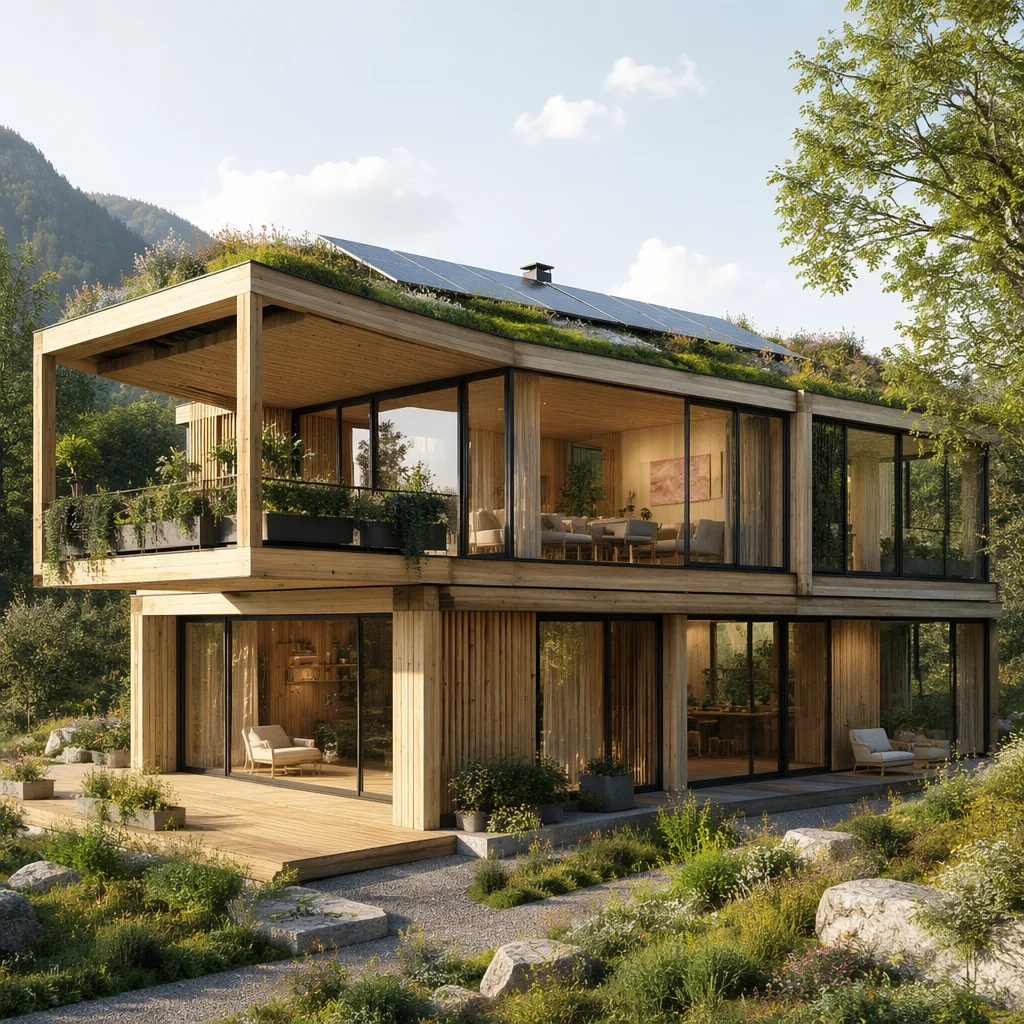
Sustainable Design

Building for a Greener Future

Modular construction is inherently more sustainable than traditional building methods. But at MODURA, we go further — engineering every module to minimise embodied carbon, maximise operational energy efficiency, and enable a circular economy where buildings can be disassembled, relocated, and reused rather than demolished.

Measurable Impact

Sustainability by the Numbers

Modular construction delivers quantifiable environmental benefits measured against conventional reinforced concrete and masonry construction.

70% Less Construction Waste

Factory production achieves material utilisation rates above 97%, compared to 80–85% on conventional sites. Offcuts are segregated at source and recycled through audited waste streams. A typical 100-unit apartment building saves over 250 tonnes of waste from landfill.

30% Lower Embodied Carbon

Steel's high strength-to-weight ratio, combined with optimised cold-formed design, reduces material mass per square metre by 25–35% versus reinforced concrete. Whole-life carbon assessment to BS EN 15978, with modules A1–A5, B1–B7, and C1–C4 reported in every project EPD.

Energy Efficiency 25% Above Code

Continuous insulation, airtight factory sealing, and thermally broken module connections deliver building envelope performance 25% above IECC 2021 and Part L 2021 baselines. Operational energy modelling to ASHRAE 90.1 Appendix G with optional net-zero-ready specification packages.

Design for Disassembly & Reuse

Bolted module connections, accessible service risers, and demountable cladding systems mean our buildings are designed for end-of-life deconstruction. Modules can be unstacked, refurbished, and redeployed — extending the building's useful life beyond a single site and dramatically reducing whole-life carbon.

Performance Data

Embodied Carbon & Operational Energy

Verified sustainability data, independently assessed through Environmental Product Declarations (EPDs) and operational energy modelling. All figures are project-specific and verified at design stage and post-occupancy.

MetricMODURA ModularConventional (RC)DeltaStandard / Method
Embodied Carbon A1–A3185 kgCO&sub2;e/m²290 kgCO&sub2;e/m²−36%BS EN 15804 +A2, verified EPD
Embodied Carbon A1–A5225 kgCO&sub2;e/m²355 kgCO&sub2;e/m²−37%BS EN 15978, including transport & site
Embodied Carbon A–C (Whole-Life)310 kgCO&sub2;e/m²520 kgCO&sub2;e/m²−40%BS EN 15978, 60-year reference period
Operational Energy (TEDI)12.5 kWh/m²/yr28.0 kWh/m²/yr−55%PHPP / ASHRAE 90.1 Appendix G
Space Heating Demand11 kWh/m²/yr45 kWh/m²/yr−76%EN ISO 13790 / SAP 10.2
Air Permeability2.0 m³/h·m² @ 50Pa7.0 m³/h·m² @ 50Pa−71%ATTMA TSL1 / BS EN 13829
Construction Waste9.2 kg/m²31.5 kg/m²−71%BREEAM Wst 01 methodology
Potable Water (Construction)0.15 m³/m²0.85 m³/m²−82%BREEAM Wat 01 methodology
Certification Contributions

LEED & BREEAM Credit Mapping

MODURA modular construction contributes to multiple credits across both major sustainability rating systems. Typical projects achieve LEED Gold (60–79 points) or BREEAM Excellent (≥ 70%).

Rating SystemCredit / CategoryTypical ContributionHow MODURA Delivers
LEED v4.1 BD+CMRc2 — Construction Waste2 points (75%+ diversion)Factory waste segregation at source, audited recycling streams
LEED v4.1 BD+CMRc3 — Building Product EPDs2 points (20+ products)Type III EPDs for steel, insulation, plasterboard, glazing
LEED v4.1 BD+CMRc4 — Recycled Content1–2 pointsSteel 85%+ recycled content, EAF production route verified
LEED v4.1 BD+CEQc1 — Enhanced IAQ2–3 pointsLow-VOC materials, factory QA, pre-occupancy flush
LEED v4.1 BD+CEAc1 — Optimise Energy10–18 points25%+ above ASHRAE 90.1, optional NZE pathway
BREEAM NC 2018Mat 01 — Life Cycle Impacts4–5 creditsWhole-life carbon assessment, Mat 01 calculator
BREEAM NC 2018Mat 03 — Responsible Sourcing3–4 creditsBES 6001 / FSC / PEFC chain of custody
BREEAM NC 2018Wst 01 — Construction Waste3–4 credits< 7.5 m³ waste per 100 m² floor area
BREEAM NC 2018Ene 01 — Energy Performance8–12 creditsEPC rating A, Ene 01 calculation to Part L
BREEAM NC 2018Hea 02 — Indoor Air Quality2 creditsLow-formaldehyde, TVOC < 300 µg/m³ at handover
Responsible Sourcing

Material Certification & Traceability

Every material specified in a MODURA building carries independent third-party certification. We maintain a live material passport for each project, tracking origin, recycled content, and end-of-life pathway.

EPD-Verified Supply Chain

All major material categories — structural steel, insulation, plasterboard, glazing, flooring — carry Type III Environmental Product Declarations (EPDs) to EN 15804 +A2, verified by independent programme operators.

FSC / PEFC Certified Timber

All timber-based products — OSB sheathing, plywood, engineered wood flooring, joinery — sourced with FSC or PEFC chain of custody certification. Zero tropical hardwood in standard specifications.

85% Recycled Steel Content

All structural steel produced via Electric Arc Furnace (EAF) route with minimum 85% post-consumer recycled content. Mill certificates to EN 10204 Type 3.1 with full chemical and mechanical traceability.

Low-VOC Interior Finishes

Paints, adhesives, sealants, and composite wood products all meet the most stringent global VOC standards: EU E1, CARB Phase 2, French A+, and LEED v4.1 low-emitting materials criteria.

Deconstructed modular building with modules being removed by crane for relocation and reuse at another site
Circular Economy

Design for Disassembly & Material Passports

Conventional buildings are demolished at end of life — an act of destruction that sends 90% of materials to landfill or, at best, downcycling. MODURA buildings are designed for a different outcome: disassembly, relocation, and reuse.

Every module connection is bolted, not welded, allowing modules to be unstacked in reverse order of erection. Service risers are accessible through demountable access panels. Cladding is mechanically fixed, not bonded, enabling material recovery at the facade level. Our material passports document every component by location, specification, and end-of-life pathway.

This approach transforms a building from a 60-year asset into a multi-generational resource. When a site's use changes, the building can be partially or fully relocated — reducing whole-life carbon by up to 60% versus demolition and rebuild.

  • 100% bolted module connections for reversible assembly
  • Demountable cladding and roofing systems, zero wet trades
  • Accessible service risers with mechanical couplings, not solvent welds
  • Material passports per module: location, grade, recycled content, EOL pathway
  • Relocation feasibility assessed as part of initial structural design
Discuss Sustainability →
70%Less Site Waste
−36%Embodied Carbon A1–A3
25%+Above Energy Code
85%+Recycled Steel Content

Build Sustainably From Day One

Talk to our sustainability team about your project's environmental targets. We provide a whole-life carbon estimate, LEED/BREEAM pre-assessment, and material specification within your first engagement.

Get Started