The US construction industry is short approximately 500,000 skilled workers as of 2026, according to Associated Builders and Contractors data. The average age of a skilled tradesperson in the US is 43, with electricians averaging 46 and plumbers 48. For every five trades workers retiring, only one new worker enters the field — a replacement ratio that makes the labor shortage a structural crisis, not a cyclical fluctuation. At the same time, global construction demand is projected to grow 42% by 2030 (Oxford Economics), requiring an estimated 41 million additional construction workers worldwide. Modular prefabricated construction is not just a different way to assemble buildings — it is a fundamentally different labor model that transforms construction from a site-dependent, weather-exposed, project-based occupation into a factory-based, climate-controlled, career-pathway industry. This article examines how modular construction addresses the skilled labor shortage at its root: by changing where the work happens, who can perform it, and how workers are trained and retained.
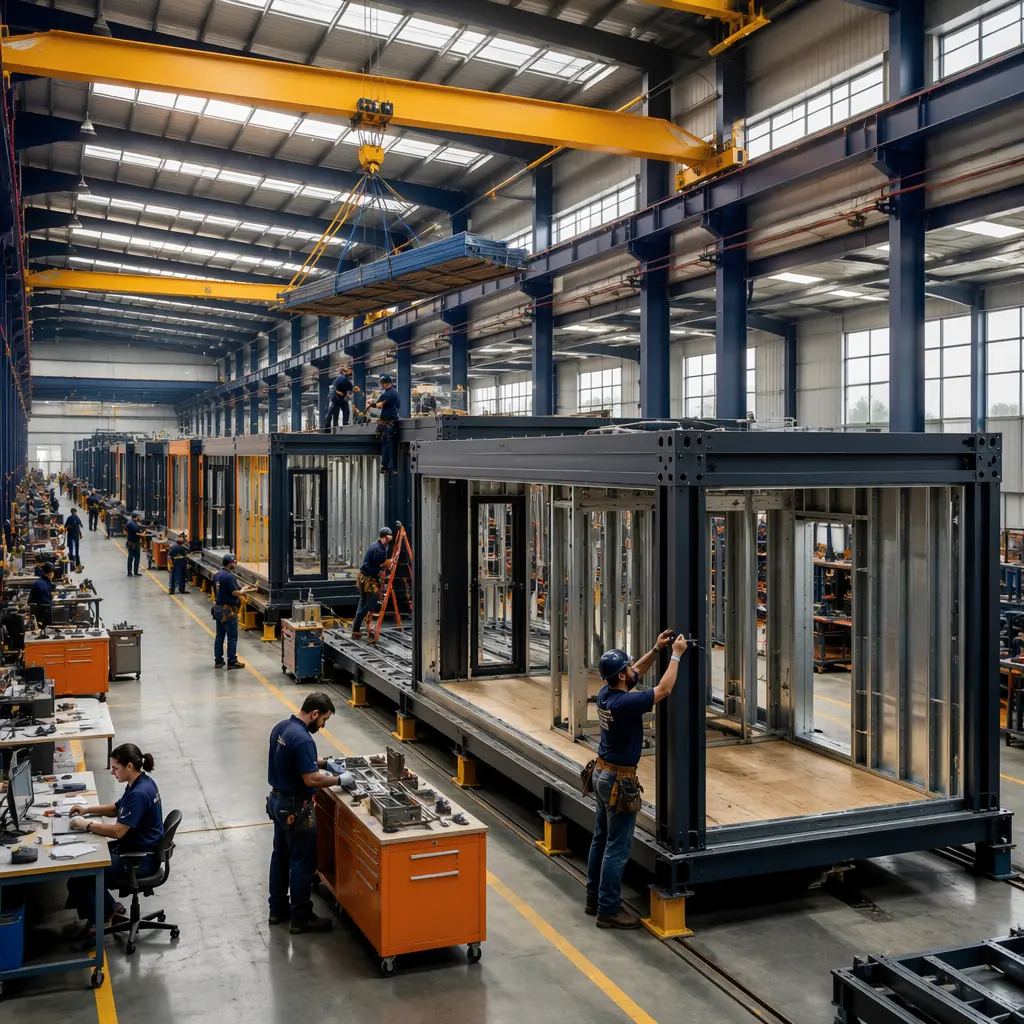
The Labor Arithmetic: Why On-Site Construction Cannot Fill the Gap
Traditional on-site construction faces structural labor constraints that no amount of recruiting — or wage increases — can solve. A conventional mid-rise apartment building (50 units, 4 stories) requires approximately 80–100 skilled workers across 12–15 trades, rotating through the site over an 18-month construction period. Each trade — framing carpenters, electricians, plumbers, drywall installers, HVAC technicians, roofers, painters, glaziers, flooring installers, elevator mechanics, fire sprinkler fitters, and finish carpenters — requires workers who are:
- Geographically available at the project site (not working on another project 50 miles away)
- Sequentially timed with the preceding trade's completion (electricians cannot rough-in until framing is complete; drywall cannot hang until MEP rough-in passes inspection)
- Willing to work outdoors in whatever weather conditions the construction schedule encounters (40% of scheduled construction days in the US Midwest lose productive hours to weather annually)
- Physically capable of the demands of their trade throughout the project duration (musculoskeletal injuries account for 33% of construction worker lost-time incidents)
In markets with low unemployment and competing infrastructure projects — the norm in North America, Western Europe, and Australia — these four constraints combine to create chronic skilled labor shortages that add 15–25% to project schedules and 8–12% to labor costs through overtime premiums, schedule compression premiums from subcontractors, and quality rework from rushed installation. Modular construction fundamentally changes this equation by shifting 70–80% of total project labor from the construction site to a fixed-location factory. Our modular vs. traditional comparison includes detailed labor hour breakdowns across building types.
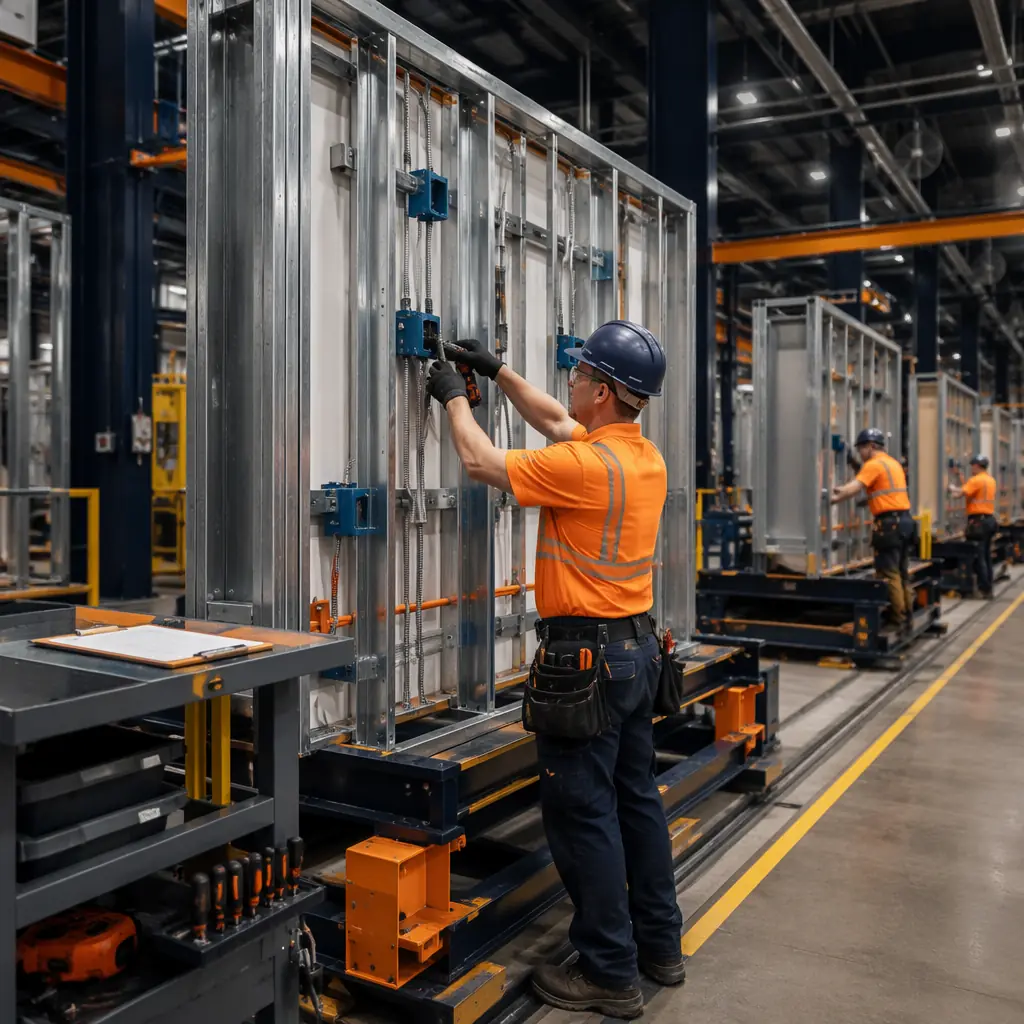
Factory Labor Model: Five Structural Advantages
Moving construction labor from site to factory transforms five dimensions of workforce dynamics simultaneously:
- Fixed location eliminates geographic churn. A site-based electrician may work on 8–12 different projects per year, each in a different location, each requiring different tools, layouts, and coordination partners. A factory-based modular electrician works in the same facility every day, on standardized module configurations, with the same team and tooling. This eliminates commuting variability, reduces non-productive travel time (typically 60–90 minutes/day for site-based trades), and transforms the job from a nomadic occupation into a stable manufacturing career — a critical factor for attracting workers who would otherwise avoid construction entirely.
- Climate-controlled environment enables year-round productivity. Site-based construction loses 25–40% of scheduled work days to weather in northern climates (frozen ground, snow, extreme cold) and 15–20% in hot climates (heat stress shutdowns). Factory-based modular production operates 52 weeks per year regardless of external weather, converting seasonal construction labor — where workers must earn a full year's income in 8–9 months — into stable year-round employment with predictable income. This alone makes modular factory jobs competitive with manufacturing and logistics careers that have been siphoning potential construction workers for decades.
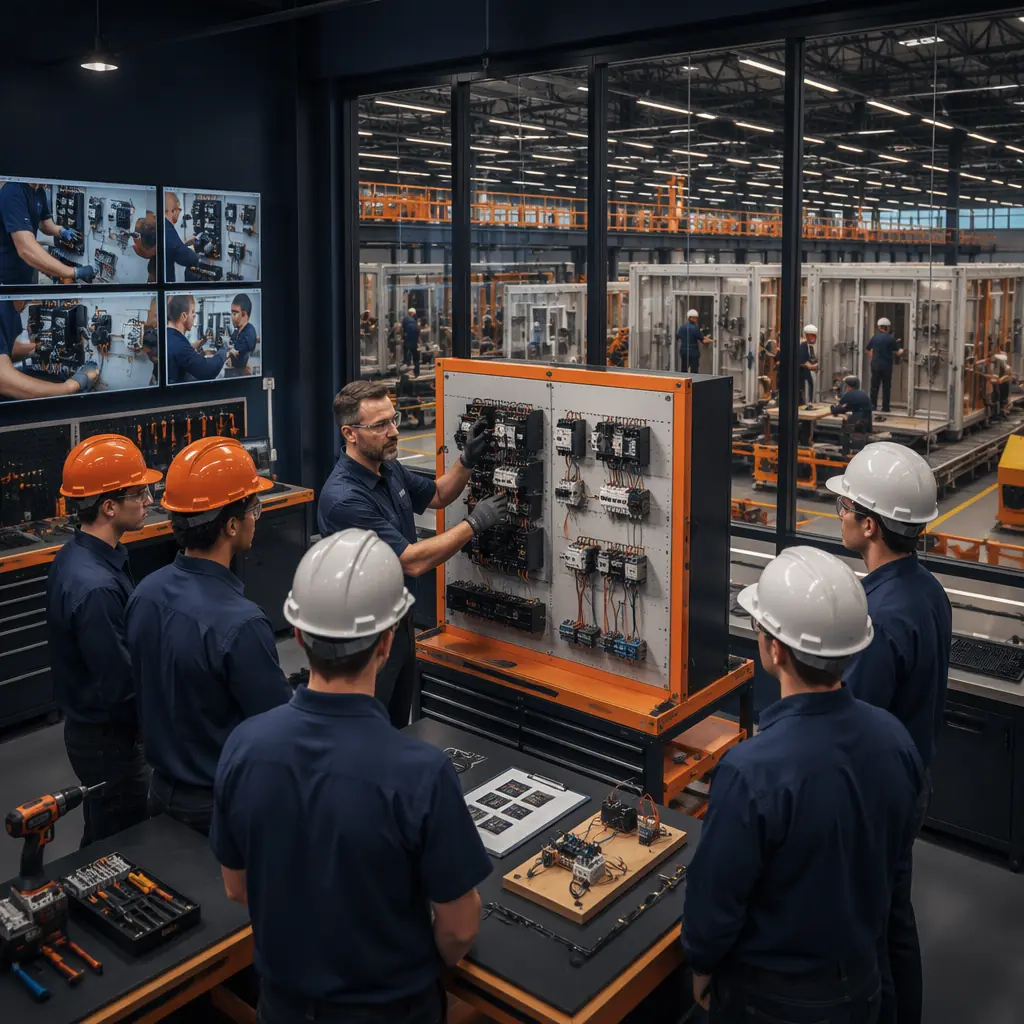
- Standardized work enables systematic training. On a traditional construction site, each project is unique — different building design, different materials, different coordination challenges. Training is ad hoc: a journeyman teaches an apprentice whatever happens to be needed that day. In a modular factory, modules are produced to standardized designs with documented assembly procedures, quality checkpoints, and skill progression matrices. A new factory worker can be trained to competency on a specific production station (e.g., electrical rough-in for a standard 12×40 ft module) in 4–6 weeks — compared to 4–5 years for a traditional electrical apprenticeship covering the full scope of site-based electrical work.
- Ergonomic optimization reduces injury and extends careers. Factory production stations are designed for the specific task: work surfaces at optimal height, tooling positioned for reach efficiency, mechanical assists for heavy components (wall panel positioners, overhead hoists for MEP equipment). Site-based construction, by contrast, requires workers to adapt their bodies to whatever the partially-built structure presents — working at height on ladders, kneeling on concrete for hours, lifting materials in awkward positions. The result: factory-based modular workers have 60–70% lower lost-time injury rates than site-based trades, and their careers extend 10–15 years longer because the work is physically sustainable.
- Career pathways attract a new generation. The construction industry struggles to attract workers under 35 because site-based trades offer no clear advancement path — a framer is a framer is a framer. Modular factories offer progression from production technician to station lead to production supervisor to plant manager — a career ladder that mirrors manufacturing industry advancement paths. Factory production roles also appeal to demographics that site-based construction systematically excludes: workers with family care responsibilities who need predictable hours, workers with physical limitations that prevent site-based work but not factory station work, and workers who prefer indoor employment.
Evaluating modular construction partners should include labor model assessment: Does the manufacturer operate a dedicated workforce with documented training programs, or do they rely on project-based subcontractors who cycle through the factory? Factory quality control systems are predicated on a stable, trained workforce — high turnover factories cannot maintain consistent quality.
On-Site Labor Remaining: What Modular Does Not Eliminate
Modular construction does not eliminate all site-based labor — it concentrates site work into fewer, more specialized tasks:
| Site Work Category | Traditional Labor Hours (per 50-unit building) | Modular Labor Hours | Reduction |
|---|---|---|---|
| Foundation and site utilities | 3,200 hours | 3,200 hours (unchanged) | 0% — foundation is always site work |
| Module setting and interconnection | N/A (no modules in traditional) | 800 hours (crane crew, connection team) | New specialized task |
| Structural framing | 6,800 hours | 0 hours (all in factory) | 100% |
| MEP rough-in | 5,400 hours (elec + plumbing + HVAC) | 900 hours (inter-module connections only) | 83% |
| Drywall and finishing | 7,200 hours | 1,200 hours (inter-module seam finishing) | 83% |
| Exterior cladding and roofing | 3,000 hours | 1,800 hours (module joint weatherproofing, roof membrane at joints) | 40% |
| Elevator installation | 1,200 hours | 1,200 hours (unchanged — elevator is always site work) | 0% |
| Site finishes (landscaping, paving) | 2,400 hours | 2,400 hours (unchanged) | 0% |
| TOTAL | 29,200 hours | 11,500 hours | 61% reduction in site labor |
The 17,700 hours shifted from site to factory represent approximately 10.2 full-time-equivalent construction workers for the duration of the project — workers who, in a traditional build, would need to be recruited, scheduled, and managed in a competitive labor market. The remaining 11,500 site hours are concentrated in foundation work (which proceeds while modules are in production), module setting (a specialized 3–4 week crane-intensive phase), and finishing (inter-module connections and cladding joints). Site safety on modular projects benefits directly from the reduced site labor footprint — fewer workers on site means fewer exposure-hours to construction hazards.
Workforce Development: Building the Modular Construction Career Pipeline
For modular construction to reach its potential as a labor solution, the industry must invest in systematic workforce development — not just competing for the same shrinking pool of trades workers, but expanding the pool by making construction careers accessible to populations that site-based construction cannot reach. The most effective workforce development strategies emerging in modular construction include:
- Modular-specific apprenticeship programs. Traditional construction apprenticeships (typically 4-year programs for electricians and plumbers, 3-year for carpenters) are designed around the full scope of site-based trade work. Modular production requires a different skill profile: focused depth on specific assembly procedures rather than broad trade scope. A modular electrical apprenticeship can be designed as a 12–18 month program covering factory electrical rough-in, testing and commissioning, quality documentation, and inter-module connection procedures — significantly shorter than the traditional 4-year electrical apprenticeship, and therefore more accessible to career changers and workers who cannot commit to a 4-year training program.
- Veteran transition programs. Military veterans possess the discipline, procedure-following orientation, and safety consciousness that modular factory production requires — but often lack trade-specific skills. Modular manufacturers that partner with military transition programs (SkillBridge in the US, Career Transition Partnership in the UK) can train veterans on factory production stations in 8–12 weeks, converting military workforce discipline into construction productivity without requiring years of trade apprenticeship.
- Community college and technical school partnerships. Modular construction factories can partner with local community colleges to create certificate programs in modular manufacturing technology — a 2-semester program covering blueprint reading, basic electrical and plumbing assembly, quality control documentation, and factory safety procedures. Graduates enter the factory as Production Technician I with a clear path to Production Technician II (supervisory responsibility) within 18–24 months. This creates a credentialed career pathway that attracts students who would never consider a traditional construction trade.
The construction industry's labor crisis is not primarily a wage problem — it is a working conditions problem and a career perception problem. Modular construction solves both by transforming construction work from outdoor, weather-dependent, nomadic labor into indoor, climate-controlled, stable manufacturing careers. Developers who choose modular construction are not just buying a faster building delivery method — they are investing in a labor model that works in an economy where the traditional construction labor model no longer does.
Turnkey modular delivery models integrate workforce management into the construction contract, giving developers a single point of accountability for both factory production labor and site installation labor. ROI analysis and cost per square foot benchmarks provide financial context for the labor cost savings modular construction delivers. For specific building types where labor savings are most dramatic, see multifamily, hospitality, and healthcare construction analyses.