Every temporary building programme has a budget line that nobody forecasts, and it is the second deployment. A site office complex, a staff village or an interim ward is bought with a business case that ends at first occupation, and then the programme moves, the project ends, or the client discovers the building is needed somewhere else, and the question of what happens next is answered by a transport quote taken under time pressure.
Relocation is where the economics of a relocatable building are actually decided, not at purchase. A modular unit designed for two moves costs more on day one and far less on the second, and the difference is not a vague quality claim: it is a set of specific design decisions, each with a line in a transport and re-installation budget. This article sets out the second-deployment cost, the design features that keep it low, and the condition assessment that decides whether moving a building is worth doing at all.
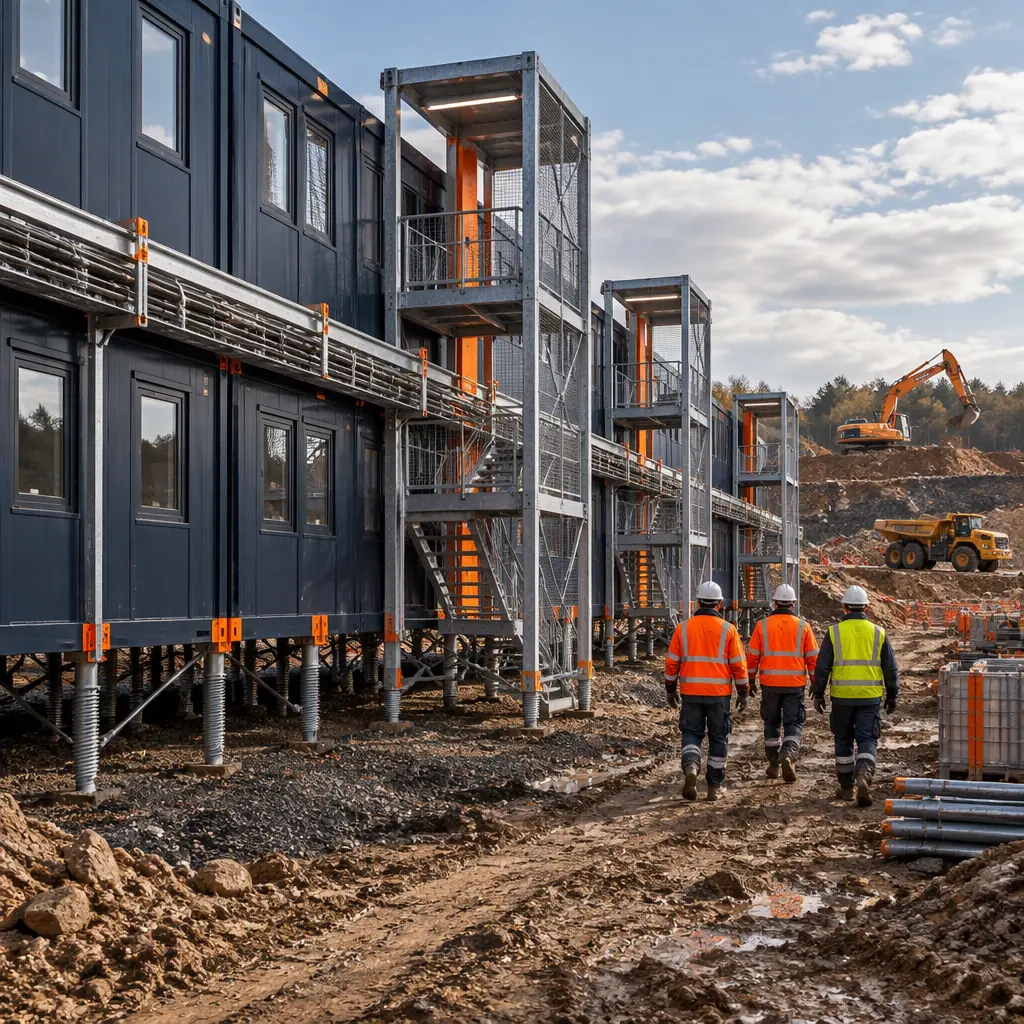
What the Second Deployment Actually Costs
The cost of moving and re-installing a modular building is best expressed as a percentage of the original supply price, because it scales with the building rather than with the site. On the relocatable units we supply, a second deployment that reuses the same foundations typically runs 22 to 34 percent of original supply price, and one that requires new foundations runs 30 to 45 percent. The gap between those two ranges is the single largest lever available to a buyer at specification stage.
The table breaks the second deployment into its components, with the quantity that drives each one. A buyer planning a two-move programme can use the middle column to specify for the second move rather than paying for it retrospectively.
| Component | Share of second-deployment cost | What drives it | How design reduces it |
|---|---|---|---|
| Disconnection and make-safe | 8–12% | Number of service entry points and whether they terminate in an accessible isolator | Single-point service entry per module with labelled isolators and plug connections |
| Lifting and loading | 15–22% | Module weight, number of lifts and whether corner castings are reusable | Four reusable lifting points per module, documented centre of gravity, no site-welded lugs |
| Transport | 20–30% | Distance and whether modules can travel at full size or need reduced sections | Module dimensions inside standard permitted envelope so no escort or night window is needed |
| Repair of transport damage | 5–12% | Whether facades and fitments are protected or dismantled before the move | Removable cladding panels and internal protection boards, corners designed as replaceable units |
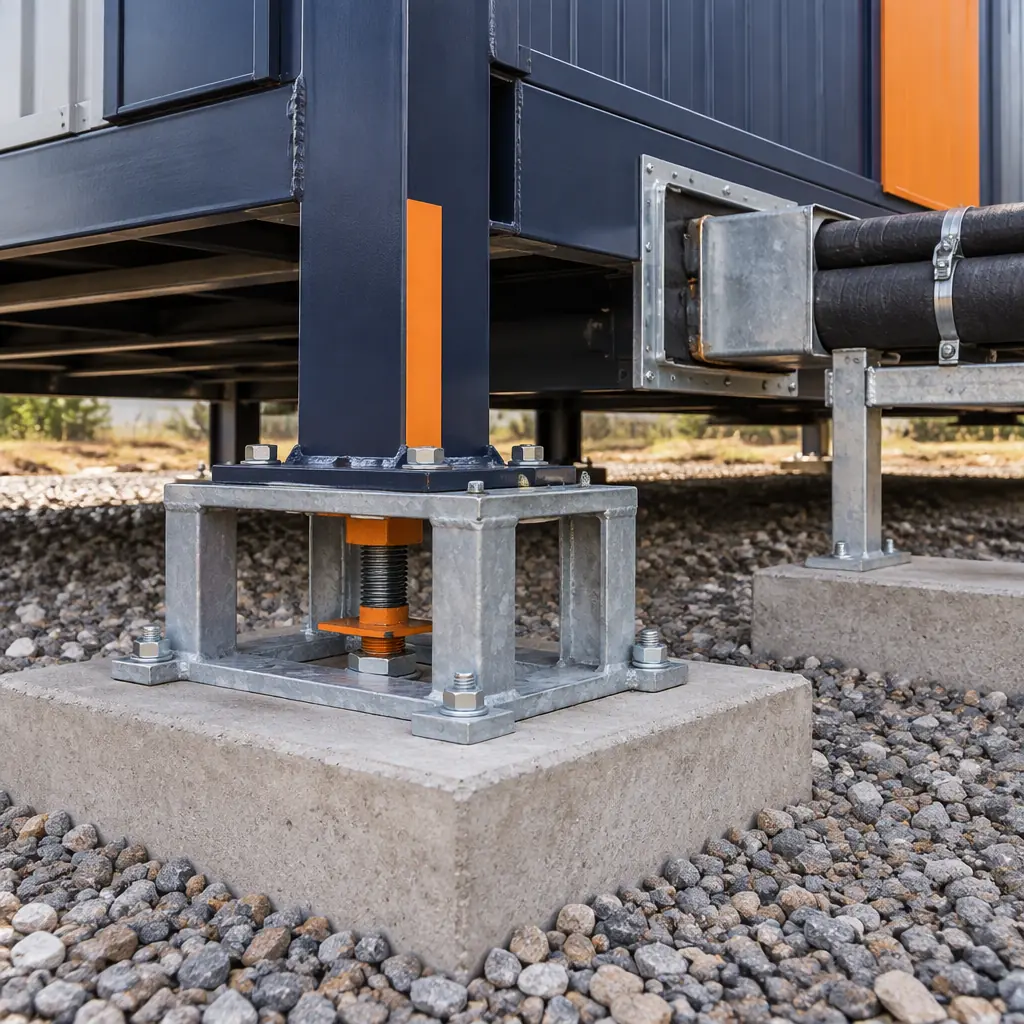
| New foundations or adaptor frames | 15–30% | Whether the second site can reuse the same footprint and leg positions | Standardised leg grid and levelling jacks that tolerate 150 mm of ground variation |
| Reconnection, testing and commissioning | 12–18% | Whether services were designed as pluggable assemblies or hard-wired on site | Plug-and-play service spines, factory-made harnesses, recorded test results reusable at re-commission |
Two of those rows deserve emphasis because they are usually decided by default rather than by design. Service entry is normally hard-wired and hard-piped by the site trade, which converts a two-hour disconnection into a two-day one and makes the connection non-reusable. Corner protection is normally an afterthought, which is how a building that was perfectly good on first occupation arrives at its second site with two damaged facade panels per module and a repair bill nobody budgeted. Both are cheap to specify and expensive to retrofit. The design characteristics behind them are covered in design for disassembly in modular construction.
The Condition Assessment That Comes Before Any Relocation Decision
Before a client commissions a transport quote, five conditions determine whether the building should be moved at all. Each is checkable in a walk-through with a camera and a tape measure, and each has a decision attached rather than a judgement.
| Check | What to measure | Decision it drives |
|---|---|---|
| Frame and lifting points | Localised corrosion at corner castings and lift points, measured remaining steel thickness against the design value | If loss exceeds 10% at the lifting points, the module is transportable but not stackable, and the second deployment configuration changes |
| Envelope and roof | Water ingress history, gasket condition at all joints, and whether the roof membrane is continuous over the module joints | Failure here is the most expensive single item. A roof that leaks at this stage will leak at the next site in a different pattern |
| Services | Age and type of cable and pipework, whether any is embedded in a way that prevents disconnection | Determines whether the services are reused, partly reused, or stripped and replaced, and this is the biggest swing in the second-deployment budget |
| Foundation compatibility | Leg positions and loadings of the existing building against what the second site can provide | Reuse of foundation type is worth 8 to 15 percent of the relocation cost |
| Alternative to relocation | Resale value in place, scrap value, and the cost of a new unit of the same specification | When relocation cost exceeds 45% of new supply price, a new unit often wins once disruption and lost use are counted |
The last row is the one clients skip and later regret. Relocation looks cheap relative to a new building because the comparison is made between the transport invoice and the supply invoice. The honest comparison is between the full re-installation cost plus the months of lost use during the move, and the net cost of a replacement building less whatever the existing unit can be sold or redeployed for. On a three-year-old, well-maintained unit on a site with an accessible second location, relocation wins clearly. On a ten-year-old unit with hard-wired services and a leaking roof line, it frequently does not, and the recommendation to replace is a service rather than a loss of work.
Programme: What a Relocation Actually Takes
Relocation tends to be sold as a fast option, and it is fast relative to new construction, but not fast in absolute terms. A two-move programme of 24 modules on adjacent sites typically runs 9 to 14 weeks from decision to second occupation, and the critical path is rarely the transport itself.
| Stage | Typical duration | What it consists of |
|---|---|---|
| Condition survey and survey of the receiving site | 1–2 weeks | Structural inspection, services assessment, set-out survey, ground investigation of the new site |
| Transport permits and route survey | 2–4 weeks, in parallel | Oversize permits, bridge assessments, escort booking, night movement windows where required |
| New foundations and service connection points | 3–6 weeks | Foundation construction and utility trenching, which can run while disassembly planning proceeds |
| Disconnection, demount and load-out | 1–2 weeks | Services isolated, modules separated, facades protected, units lifted onto trailers |
| Transport | 2–5 days per convoy | Depending on distance and the number of permitted movements per night |
| Setting, reconnection and re-commission | 1–3 weeks | Follows the original setting sequence, with re-testing of all services and re-certification |
| Compliance re-approval | 2–8 weeks, often the critical path | New jurisdiction, possibly a different authority, with a new permit set and possibly new wind and seismic requirements |
Compliance re-approval is the item that surprises clients most. A building that is fully approved in one jurisdiction is a new application in another, and the structural design may need re-checking against a different snow, wind or seismic map. The engineering is rarely difficult, because the frame is already over-designed for a transport case, but the calendar time is real and it runs on the authority's clock rather than the factory's. Where the move crosses a national border the sequence adds customs treatment of a used building, which is a separate exercise and is covered in cross-border modular logistics.
Specifying for Two Moves Instead of One
Six specification decisions cost a small premium on the first order and remove most of the cost and risk from the second deployment. Each is a line item a buyer can ask for by name.
Reusable lifting and anchoring points. Corner castings designed for repeated lifting with an inspectable, replaceable insert rather than a cast-in lug. Cost premium on the frame is roughly 1 to 2 percent and it removes the single most common reason a second lift is refused by the lifting contractor.
A documented centre of gravity per module. Stamped on each module and carried in the handover pack, with the lifting rig and sling angles specified. Without it, every move begins with a crane engineer recalculating what the factory already knew.
Pluggable service spines. Services terminating in a factory-made harness with an accessible connection point, tested at the factory and re-testable at the new site. This is the single biggest determinant of the reconnection line and the one most often sacrificed to save first-cost.
Removable facade panels and replaceable corners. Cladding that lifts off for transport and corners that are a replaceable component rather than a fabricated return. Transport damage stops being a repair programme and becomes a parts order.
A standard leg grid. The same leg positions across every module in the order, so foundations at the second site can be cast from the same drawing. This is what makes the 8 to 15 percent foundation saving real rather than theoretical.
A relocation dossier at handover. As-built drawings, lift plan, service schematics, test records and the re-commissioning procedure, issued as a package. Where the dossier exists, the second deployment planning stage drops from two weeks to a few days because nothing has to be investigated. The link between this document and the building's value at resale is set out in modular building resale value.
Remote and Fast-Cycle Programmes, Where Relocation Changes the Business Case
There is a class of project where relocation is not an optimisation but the whole commercial model: workforce housing that follows a construction programme, exploration camps that move as the deposit is worked, event and broadcast facilities that relocate seasonally, and disaster response accommodation held in readiness rather than placed permanently. In these programmes the building is an asset that is used four or five times, and the second-deployment arithmetic dominates the investment case.
On a five-move workforce camp, the difference between a unit designed for relocation and one designed to be permanent is the difference between an asset with a usable life of 12 to 15 years and one that is scrapped after the first project. Applied to a 200-bed camp, that is a decision worth several million dollars over the asset life, and it is taken entirely at specification stage, before any site exists. Our workforce housing guide and disaster relief and emergency housing pages cover the configurations used in those programmes, and temporary and relocatable facilities covers the wider building types.
What We Decline to Promise on Relocation
We will not quote a relocation price without inspecting the building. A price based on the original specification assumes the building is in the condition it was delivered in, and after a few years on a working site it rarely is. The survey is one day and it is the difference between a price and a guess.
We will not warrant re-approval in a new jurisdiction. We will prepare the permit set, re-run the structural checks against the new location's wind and seismic criteria, and support the application. The decision belongs to the authority, and any supplier who guarantees it is guaranteeing somebody else's signature.
We will not move a module with corroded lifting points. This is a hard line rather than a commercial one. Where the remaining section at a corner casting is below the transport requirement, the module is lifted with a frame or not at all, and the cost of the frame belongs in the budget from the start.
We will not present relocation as cheaper than a new unit when it is not. Past roughly 45 percent of new supply price, with lost use counted, replacement frequently wins, and the assessment we issue will say so even though it ends the relocation.
Questions Asked Before Every Relocation Contract
| Question | What we answer |
|---|---|
| How many times can a module actually be moved? | On a well-specified steel-framed unit, four to six moves over a 15-year life with inspection at each one. The limits are the lifting points and the envelope, not the frame, and the fifth move usually coincides with a services refresh rather than a structural problem. |
| Can the foundations be reused? | Only if the new site uses the same leg grid and the ground conditions are similar. Screw piles and jacks are the reusable option and are the reason the relocation cost drops by 8 to 15 percent when the grid is standardised. |
| What is the lost-use cost during the move? | Typically three to six weeks of vacancy for a site office complex and four to eight weeks for accommodation, dominated by re-commissioning and re-approval rather than transport. It belongs in the comparison against a new unit, not in a separate contingency. |
| Does the warranty survive a move? | The structural warranty does, subject to an inspection and a documented re-lift. Component warranties generally restart or transfer on the components replaced during the move. The position should be written into the original contract, and the framework is described in warranties and structural guarantees. |
| Can part of the building move and part stay? | Yes, and it is a common configuration: the permanent core stays, the relocatable wings move. It requires the services to be separated at the interface from the start, which is a design decision rather than a construction one. |
| What is the honest total cost of a second deployment? | 22 to 34 percent of original supply price where foundations are reused, 30 to 45 percent where they are not, plus three to six weeks of lost use. We will not quote the transport line alone and call it the answer. |
How to Plan a Two-Move Programme
Four planning decisions take most of the risk out of a relocation programme, and all four are cheaper taken at the start.
Nominate both sites before ordering. Not always possible, but where the second site is known the leg grid, the service entry side and the transport route can all be designed for it. A relocation designed against a specific second site costs materially less than one designed against a hypothetical one.
Design the services to be separated. The relocation line lives or dies on whether the services can be disconnected, stored and reconnected. A single service entry per module, pluggable at the boundary, is the specification that makes everything else straightforward.
Book the compliance route early. The re-approval timeline is the critical path and it belongs to the authority. Starting the permit conversation at the same time as the transport booking, rather than after it, is the difference between a nine-week and a fourteen-week programme.
Budget the second deployment at the start. A business case that includes the second-deployment range from the outset is a business case that survives contact with reality. Where the client knows the range before ordering, the specification decisions above get taken on economics rather than on price per unit, which is the wrong basis for a building that will be used twice.
Planning a building that will move at least once? Send us both sites and we will return the second-deployment budget with the specification items that pay for themselves on the second move.